
You’re preparing for a trip and planning to tuck an envelope of cash into your luggage. It doesn’t take long to wonder how much you’re allowed to carry, and the answer isn’t as simple as a single figure. The €10,000 threshold triggers a declaration requirement; it does not prohibit you from carrying cash. Confusing the two can lead to a hefty fine or even the seizure of your funds. Here’s what you need to know before going through customs.
Customs declarations in France: what the €10,000 threshold really means
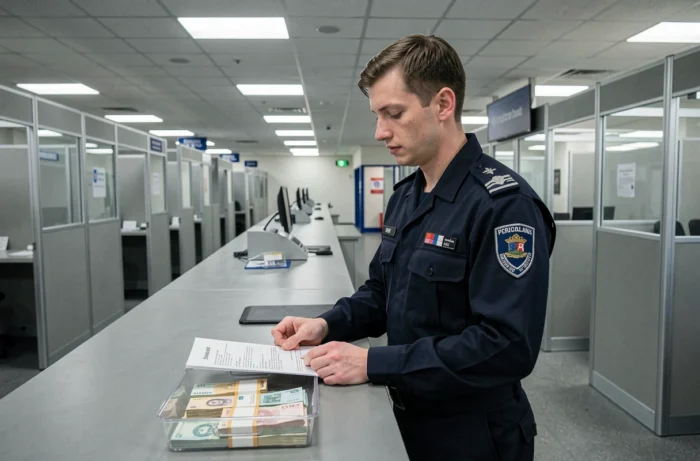
Carrying €10,000 or more in cash (banknotes, traveler’s cheques, or gold that can be readily converted into cash) means you must file a declaration with French customs. The DALIA online service lets you do this before departure. If you fail to complete this formality, customs officers may hold the funds and impose a fine.
This threshold is not a cap. You can legally travel with a larger amount, provided you declare it and can prove where the funds came from. Depending on the circumstances, a bank statement, bill of sale, or notarial certificate may be sufficient.
When it comes to cash at the airport, many people assume there’s an absolute limit. There isn’t: the offense is failing to declare the money, not the amount itself.
One point that’s often overlooked: the declaration applies to physically carrying money, not to bank transfers. Sending €15,000 by bank transfer to a foreign account is not subject to this customs requirement. The rule applies to cash, cheques, and negotiable instruments that you carry on your person or in your luggage.

Travel outside the EU or between European countries: two different sets of rules
French customs distinguishes between two situations, depending on your destination.
Travel to a country outside the European Union
You must file a declaration with French customs before departure, and then with customs in your destination country if required. A French declaration never replaces the formalities required by your destination country. Some countries set lower thresholds or impose specific restrictions on foreign currencies.
Travel between EU member states
Declaration requirements also apply to travel within Europe, but under a separate legal framework. The €10,000 threshold remains the benchmark, and a declaration may be required during a customs check even within the European area.
Why does this distinction matter? Because a traveler going from France to Switzerland (outside the EU) and one going to Spain (within the EU) don’t fill out the same forms or answer to the same authorities.
Proof of where the funds came from: the document no one thinks to prepare
Declaring an amount is one thing. Proving where it came from is another. Customs officers may ask for proof of the source of the funds, especially when you carry more than the declaration threshold. Without documentation, even a properly filed declaration can lead to complications.
Here are some of the most common supporting documents:
- A bank statement showing the recent withdrawal of the amount you’re carrying
- A bill of sale (for a vehicle, property, or valuable item) if the money came from a transaction
- A notarial certificate in the case of a gift or inheritance
- A currency exchange receipt if you exchanged money before departure
Preparing this documentation before your trip can save you hours of delays at customs. Customs officers don’t have access to your banking history. It’s up to you to provide proof.
Rules in your destination country: the most common pitfall
Most travelers check the French rules and forget about those in their destination country. Each country sets its own thresholds and penalties.
Some countries require you to declare amounts below €10,000. Others prohibit the import of certain currencies or restrict how much of their national currency you can take out of the country. Checking the customs rules in your destination country is just as important as declaring your cash in France.
French customs itself recommends checking these rules. A traveler who complies with the rules at departure may still break the law on arrival if they don’t know the local regulations.
The best approach is to check the website of your destination country’s embassy or consulate before you leave. The information is generally up to date and, for the most popular destinations, available in French.
Payment strategy for travel: combine cash and bank cards
Traveling with a large amount of cash isn’t always the best option. Declaration requirements, the risk of theft, and the need to prove where the money came from can quickly add up.
A safer approach is to combine several payment methods:
- A modest amount of cash for initial expenses (taxis, tips, and small shops without card terminals)
- A primary bank card with payment and withdrawal limits suited to your trip
- A backup card on a different network, kept separate from your main wallet
Before you leave, check your card limits and ask for a temporary increase if needed. Two cards on two different networks cover almost every situation.
This strategy reduces your reliance on cash, limits the risks associated with theft, and simplifies customs formalities. It doesn’t eliminate the need for cash, but it keeps the amount reasonable and well below the declaration threshold.
The real risk of carrying cash when you travel isn’t how much you take with you. It’s setting off without knowing which rules apply, both in France and at your destination. A declaration that takes five minutes to complete and proof of the funds tucked into your travel documents are enough to avoid most unpleasant surprises.