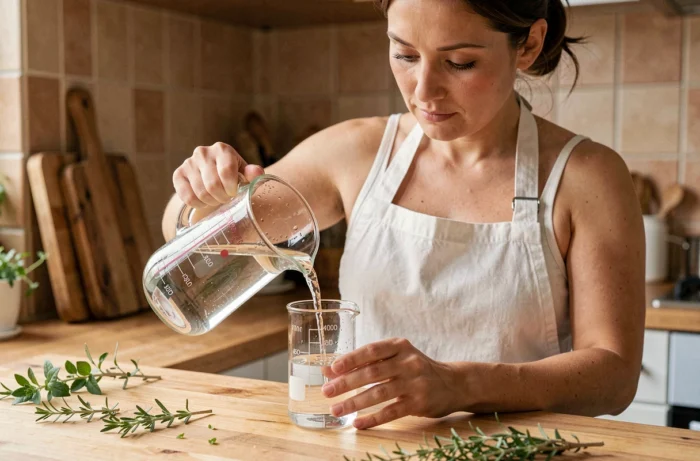
Your recipe calls for 250 ml of milk, but the measuring jug on the counter only has centilitre markings. Don’t panic: converting millilitres to centilitres takes just one simple calculation, as long as you don’t confuse volume with weight along the way.
Centilitre markings, millilitre recipe: the real challenge when measuring
The problem isn’t the calculation. It’s the equipment. Many measuring jugs sold in France are marked in centilitres (cl), sometimes decilitres (dl), and less often millilitres (ml). Recipes, meanwhile, use all three units depending on where they come from.
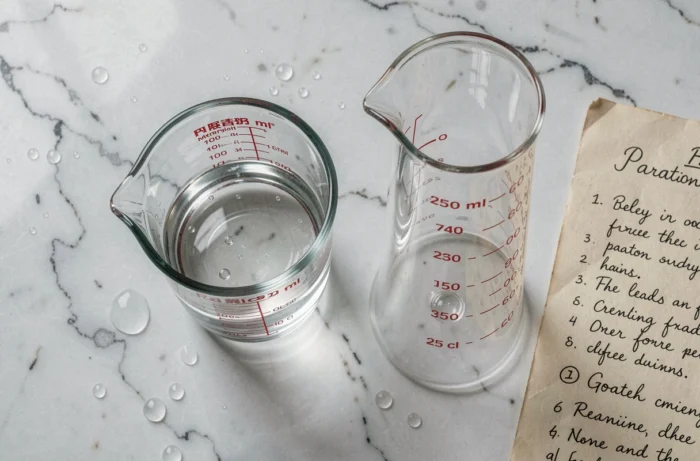
Before converting anything, turn your measuring jug around and check the unit printed beside the markings. The same line marked “25” doesn’t represent the same amount if it means 25 ml, 25 cl or 25 oz. This simple habit prevents most measuring mistakes.
If you’re looking to find out how many centilitres are in 250 ml, the answer is one division: 250 divided by 10, which equals 25 cl. This rule works for any quantity, not just 250 ml.
Converting millilitres to centilitres: the one rule to remember
One centilitre contains exactly 10 millilitres. So, to convert ml to cl, simply divide the number of millilitres by 10. To convert the other way, multiply by 10.
Ever noticed how many conversion charts are available online? In reality, one simple principle replaces them all.
- 100 ml equals 10 cl (a small glass)
- 250 ml equals 25 cl (a large glass or a quarter of a litre)
- 500 ml equals 50 cl (half a bottle)
- 750 ml equals 75 cl (a standard bottle of wine)
The calculation doesn’t depend on the ingredient, the temperature or the liquid’s density. Converting ml to cl is purely mathematical, because both units measure volume.
Volume and weight in cooking: the confusion that throws off measurements
Here’s the pitfall that conversion charts almost never explain. When a recipe says “250 ml of flour”, it refers to a volume. When another says “250 g of flour”, it refers to a weight. These are not the same amount.
250 ml of water weighs about 250 g, but 250 ml of oil or flour does not weigh 250 g. The reason is simple: every ingredient has its own density. Oil is lighter than water for the same volume. Packed flour takes up less space than aerated flour.
In practice, this means two things:
- If the recipe gives a volume (ml or cl), measure it with a measuring jug, not a scale
- If the recipe gives a weight (g or kg), use a scale, not a measuring jug
- Never replace “250 ml” with “250 g” without checking the density of the ingredient in question
For water, this shortcut works. For anything else, it could ruin pancake batter or a cake.
When your measuring jug shows neither ml nor cl: adapting your measurements
Some imported utensils have markings in cups (US cups) or fluid ounces (oz). In that case, you’ll need an extra reference point to convert to centilitres.
If your recipe calls for 25 cl (or 250 ml), check the exact capacity of your cup before measuring. For savoury dishes, a small difference is negligible. For baking, it’s best to use a measuring jug marked in metric units.
Tip for small quantities
The markings on a large measuring jug (50 cl or more) are often spaced 5 cl apart. This makes it difficult to measure 2 cl or 3 cl accurately. A tablespoon can provide a more reliable guide for small amounts such as sauces, flavourings and extracts.
Read the level accurately
Place the measuring jug on a flat surface. Crouch down so your eyes are level with the liquid. Reading the level from above gives an inaccurate measurement because of parallax: the liquid appears higher or lower than it really is. This matters most when measuring precise quantities for baking.

Remember common conversions without a chart
Instead of looking up a chart for every recipe, start with a litre and divide. One litre is 100 cl or 1,000 ml. A quarter of a litre is 25 cl or 250 ml. Half a litre is 50 cl or 500 ml.
These three reference points cover most measurements in French recipes. You can work out the rest in your head by moving the decimal point one place.
Converting 250 ml to centilitres gives you 25 cl, and the same calculation works for any amount. The real time-saver isn’t the formula, but getting into the habit of checking the unit on your measuring jug before pouring—and never substituting weight for volume without knowing the ingredient’s density.


