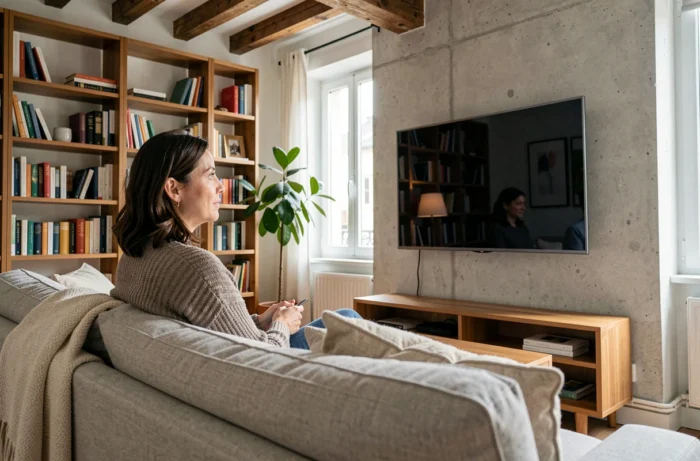
The French television landscape is not just a screen turned on in a living room. It is an ecosystem where historical channels, digital platforms, public regulators, and thousands of image and sound professionals intersect. Understanding this universe means grasping how information, fiction, and documentaries reach us, and why their production is changing profoundly.
Restructuring of DTT in France: what changes concretely
Have you noticed that some channel numbers have shifted on your remote? This is not a bug. DTT, the bouquet of free channels received via antenna, underwent a significant restructuring in 2025. The channel NOVO19, for example, began broadcasting on channel 19 on September 1 of that year.
Behind this simple change of number lies a process driven by Arcom (the authority that regulates audiovisual media in France). Arcom launched a call for applications in October 2026 for six free frequencies whose licenses are expiring. The principle: companies propose a channel project, and the regulator selects those that will be granted the right to broadcast.
This mechanism keeps DTT dynamic. Channels disappear (NRJ12 has left DTT), while others emerge. For viewers, the direct consequence is a regular renewal of the free programming offer. For audiovisual production professionals, each new channel represents a potential outlet for their content.
When one wishes to access the Euromedia Television website, one realizes the diversity of technical players that make the broadcasting of these programs possible, from the production truck to the production studios.
Funding of audiovisual production: who pays what
A documentary, a series, an information magazine: each program broadcast has been financed before being filmed. Understanding who puts money on the table helps to grasp why some genres thrive while others decline.
Television channels remain the primary contributors to the funding of French and European production. They invest in fiction, documentaries, and animation in exchange for broadcasting rights. This model has existed for decades.
The novelty comes from video-on-demand platforms (SMAD, or audiovisual media services on demand). According to Arcom’s report, these platforms are increasing their investments in French production while channels are declining. The trend indicates a gradual shift in funding.
This shift has direct consequences on programming:
- Fiction is declining on free channels, partly because budgets are migrating to platforms that favor series with high international visibility.
- Documentaries are gaining ground in the schedules of free channels, notably supported by the arrival of new channels on DTT that focus on this less expensive genre to produce.
- Documentary production supported by the CNC (National Center for Cinema) did, however, decrease in 2025, indicating that abundant supply does not always come with adequate financial support.
Jobs in audiovisual in France: the human chain behind the screen
A television program involves dozens of different professions before it reaches your screen. Let’s take the example of a report broadcast during the news. A writer-journalist defines the angle. A cameraman films the images. A sound engineer captures the interviews. A video editor assembles everything. A director supervises the presentation.
Each technical link corresponds to a distinct profession with its own training and skills. The sector generally distinguishes several families: image (cameraman, director of photography), sound (sound engineer, boom operator, foley artist), post-production (editor, colorist), and production (producer, assistant director).
These professions are not limited to television. Cinema, radio, corporate communication, and online video recruit the same profiles. The boundary between television and digital production is blurring: the same editor may work on a program for a channel on Monday and on a series for a platform on Tuesday.
Documentary and transparency: a challenge for authors
The documentary occupies a special place in the French audiovisual landscape. A genre historically supported by public channels, it also permeates digital media and social networks.
A structural problem persists for authors. The Scam (Société civile des auteurs multimédia) notes that many documentary authors do not have the final production accounts of their last contract. In plain terms: a director can deliver a film without ever knowing precisely how the budget was spent.
This opacity hinders authors’ ability to negotiate their next contracts and to verify that their remuneration corresponds to the commitments made. The issue of financial transparency in audiovisual production goes beyond the case of documentaries, but it is in this genre, often supported by small structures, that the imbalance is most felt.
Television and digital in France: coexistence rather than replacement
The idea that platforms will replace traditional television has been circulating for years. The reality of the French media landscape is more nuanced. Channels, platforms, and social networks coexist and feed off each other.
A channel like franceinfo broadcasts its content both on DTT, on its website, and on YouTube, where it holds a leading position in news. Programs produced for television are repurposed, edited, and redistributed across digital media.
This coexistence redefines the skills expected in communication and audiovisual culture professions. A television journalist must think about short video formats for social media at the same time as long subjects for the air. A producer must negotiate broadcasting rights that cover both linear and on-demand.
The French audiovisual landscape remains a field where the search for new economic models coexists with structures inherited from several decades of public regulation. The upcoming allocation of DTT frequencies, expected at the end of 2027, will redraw the map of free channels and, with it, new opportunities for program production in France.


