
We recover a bouquet of lilies whose flowers are starting to wilt, and the idea arises: why not try to regrow a plant from these stems? The instinct is logical, but the botanical reality of the lily requires understanding what we actually have before pulling out a pot and potting soil.
Stem from a bouquet or bulb: what cut lilies really allow
A lily stem bought from a florist has been separated from its bulb. This is a crucial point because the bulb is the storage organ of the lily, the one that stores the energy necessary for producing roots and new shoots. Without it, the stem alone does not have the resources to root in a substrate.
Unlike some plants that can be easily propagated in water (basil, pothos), the lily does not form adventitious roots from a cut flower stem. It can be placed in a vase to extend flowering for a few days, but one should not expect to see rootlets appear.
The only exception concerns varieties that produce bulbils, these small round structures that form in the leaf axils on the stem. The tiger lily is the most common example. If your bouquet contains them and these bulbils are firm enough, then we have a real starting point to grow a lily at home.
Identifying and recovering bulbils on a lily stem
Bulbils look like small dark green or brown pearls, nestled between the stem and the base of the leaves. Not all lily varieties produce them. In a typical bouquet made up of Asian or Oriental lilies, their presence is rare.
To spot them, inspect the stem along its entire length once the flowers have wilted. If bulbils are present, they detach easily with a light thumb pressure. Each bulbil is an embryo bulb capable, in time, of producing a new plant.
Bulbils do not bloom in the first year. It takes several growing seasons before obtaining a bulb mature enough to produce a flower stalk. Thus, we enter a project of patience, not a quick trick.
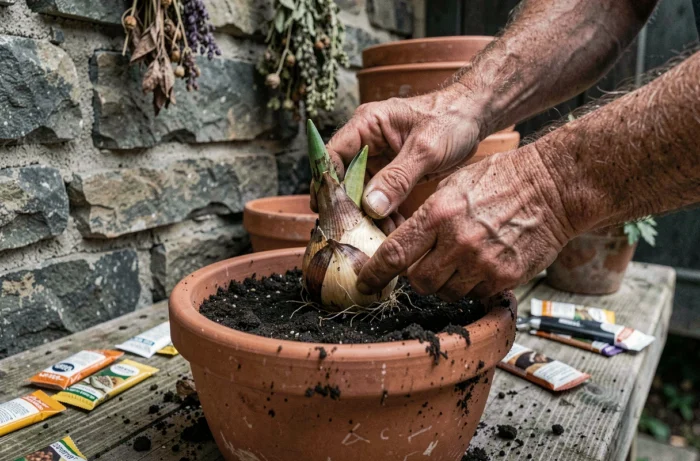
Planting lily bulbils in pots: substrate, depth, and watering
If you have recovered bulbils, pot planting is the simplest method to start indoors.
- Choose a pot at least fifteen centimeters deep, with drainage holes at the bottom, and fill it with a mixture of potting soil and coarse sand (about one-third sand to two-thirds potting soil).
- Bury each bulbil at a depth equivalent to twice its size, point up, spacing a few centimeters apart if planting several in the same container.
- Water moderately after planting to moisten the substrate without soaking it. The lily hates standing water, which causes young bulbs to rot.
- Place the pot in a bright location but out of direct scorching sunlight, at room temperature.
The first shoots may take several weeks to appear. Keep the substrate slightly moist, without excess. Too wet potting soil is the primary cause of failure when trying to grow a lily in a pot.
When to repot or plant in the ground
Once the young plant has developed a few solid leaves and the bulb has grown (often after a full season), it can be transferred to a larger pot or directly into the ground in the garden. The lily prefers well-drained soil rich in organic matter and a sunny location with the base in the shade.
Planting in the ground is ideally done in the fall when the plant goes dormant. The bulb then settles into the soil over the winter and resumes growth the following spring.
Propagation by scales: the alternative when you have a bulb
If your starting point is not a bouquet but a lily bulb (recovered from a garden, given, or purchased), the scale technique offers more reliable possibilities than bulbils.
The scales are the fleshy layers that make up the bulb, somewhat like the layers of an onion. Each scale can produce a new small bulb if it is cleanly detached and placed in the right conditions.
- Gently detach a few scales from the outer edge of the bulb by pulling downward. Use a clean knife if they resist.
- Place the scales in a plastic bag containing slightly moist vermiculite or peat, then seal the bag.
- Store the bag in a warm place (around room temperature) for a few weeks. Tiny bulbils will form at the base of the scales.
- Then plant these new bulbils in pots, following the method described above.
This technique requires starting from a living bulb. A bouquet stem, even fresh, does not contain exploitable scales. This is the distinction to keep in mind: without a bulb, no propagation by scales.

Caring for the young potted lily: light, fertilizer, and winter rest
A lily grown from bulbils or scales remains fragile during its first seasons. Care relies on three simple axes.
Light first: the lily needs several hours of sunlight each day. Indoors, a south or west-facing window works well. If the stems are stretching and elongating without producing broad leaves, it is a sign of insufficient light.
Fertilizer next: a light application of flowering plant fertilizer in early spring supports bulb growth. Avoid fertilizing in winter when the plant is dormant.
Winter rest finally: the lily needs a cold period to restart its cycle. In pots, the container can be placed in an unheated garage or on a balcony protected from extreme frost. Winter dormancy conditions future flowering.
Transforming a bouquet of lilies into a living plant is only feasible if the stem carries bulbils, which limits the varieties concerned. For other cases, starting from a fresh bulb remains the most direct route. The lily rewards patience: the first bloom after home propagation does not arrive for several seasons, but the result is worth the wait.


