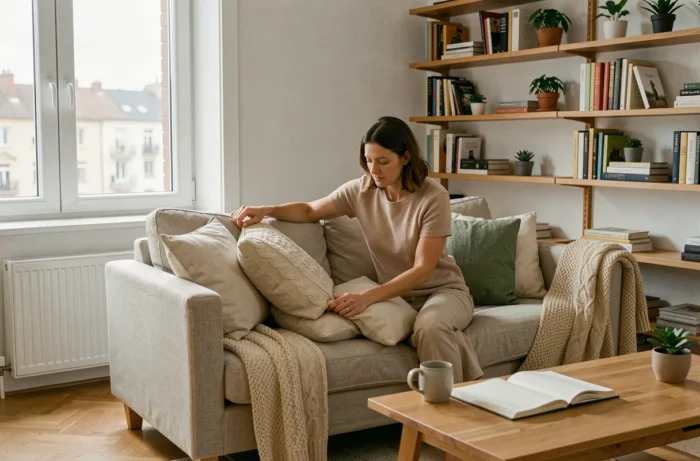
The renovation market often encourages adding things: new furniture, new partitions, new equipment. Yet some of the most lasting comfort improvements come from making better use of what is already in the home. Rethinking the layout, addressing thermal comfort issues or improving indoor air quality can transform everyday life without piling on purchases or major construction work.
Summer thermal comfort: when insulation makes overheating worse
Insulating a home reduces heat loss in winter, but the opposite can happen in summer. An analysis published by Modes & Travaux in October 2026, based on energy audits, reports that a significant proportion of recommended renovations could make summer heat worse. The problem stems from incomplete reasoning: walls and roofs are treated without taking window orientation, the building’s thermal mass or solar shading into account.
The DPE’s summer comfort rating also has its limitations. It does not always reflect the reality of living in a renovated home. An apartment under the roof, perfectly insulated but without external shutters or ceiling fans, can become unbearable as early as June.
Checking three things before starting insulation work can make all the difference:
- Whether there is external solar shading (shutters, blinds, awnings) on south- and west-facing façades to block sunlight before it passes through the glass.
- The thermal mass of interior walls: a stone or concrete wall absorbs heat during the day and releases it at night, naturally regulating the temperature.
- Whether cross-ventilation is possible—that is, whether there are openings on two opposite façades to create an effective airflow after sunset.
Addressing these factors does not require tearing anything down. Installing shutters on an existing window or clearing an airflow path blocked by a poorly placed piece of furniture can sometimes improve comfort by several degrees.

Indoor air quality: an invisible aspect of comfort that is often overlooked
Making a home more airtight without reviewing its ventilation creates a trap. Moisture builds up, condensation appears on windows and air quality deteriorates. Resources such as those available at homedome.fr can help identify the right equipment for each type of home.
The Ministry for Ecological Transition, as reported by Actuya in October 2026, highlights a few simple but rarely followed steps: air out your home every day and never block ventilation grilles. These grilles, often blocked to prevent drafts or noise, ensure a minimum level of air exchange. Sealing them off is like turning your home into an airtight box.
After insulation work, air inlets and extraction vents should always be checked. A clogged ventilation system or one that is undersized for the building’s new level of airtightness can no longer do its job. The result: mold in corners, lingering odors and breathing discomfort.
What you can fix without installing a new system
Cleaning the ventilation system’s extraction vents twice a year can noticeably improve airflow. Checking that the air inlets above the windows have not been painted over, taped up or blocked by a seal takes just five minutes.
Moving a piece of furniture that blocks a ventilation grille can solve a persistent damp problem in a room. This costs nothing and can produce measurable results within a few weeks.
Adapt circulation routes for comfort and long-term independence
A home’s comfort is about more than temperature or décor. How you move from room to room, access the bathroom or climb the stairs shapes your quality of life every day, especially as you get older.
Making stairs safer and adapting the bathroom can help you stay in your home longer and remain more independent. Well-positioned grab bars, non-slip flooring in the shower or automatic lighting in the hallway at night are simple changes that can radically improve how a home works.
These adaptations are not just for older people. A young child, someone recovering from an illness or simply someone carrying heavy items can all benefit from a clear hallway, a well-lit step and a sufficiently wide doorway.
Rethink the layout before adding furniture
The usual temptation is to buy a new piece of furniture to solve a storage or circulation problem. Rearranging what you already have often works better. Moving a sideboard from the entryway to the living room clears the main walkway. Replacing a tall shelf with low storage makes items easier to reach.
Clear floor space has a much greater impact on how comfortable a home feels than the amount of furniture it contains. Fewer obstacles in walkways mean less fatigue, fewer risks and a greater sense of space, even in a small home.
Create a harmonious atmosphere without redecorating
A harmonious interior depends largely on the light and materials already in place. Changing the color temperature of light bulbs—for example, switching from cool white to warm white in the living room—can change the feel of a room without repainting a single wall.
Textiles play a similar role. Adding a thick curtain in front of a poorly insulated window improves thermal comfort, acoustics and appearance all at once. A throw on an aging sofa gives it a new lease of life without replacing it.
A common pitfall is mixing too many styles and decorative objects. Removing things rather than adding them often has a clearer impact. Three carefully chosen pictures on a wall look better than ten arranged without any sense of cohesion. This less-is-more approach reflects the principle behind the whole process: improving comfort at home starts with making better use of what is already there.
A comfortable, practical and harmonious home does not require a large renovation budget. Targeted thermal improvements, ventilation maintenance, better circulation and making the most of existing lighting and textiles can transform everyday life. Lasting comfort comes less from what you add than from what you fix.


