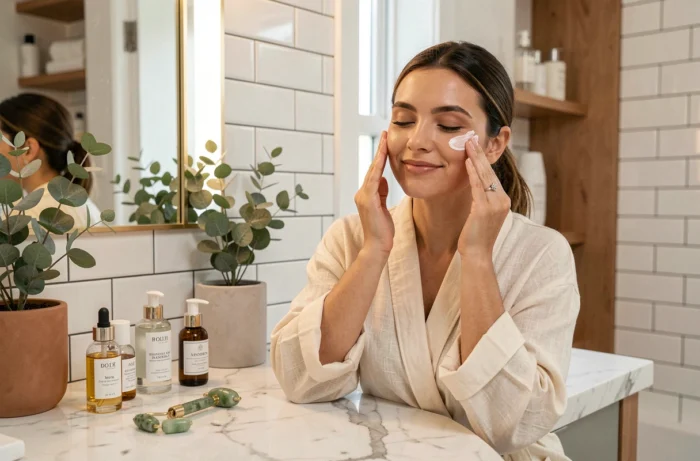
Beauty trends circulating on social media and in magazines are based on mechanisms that are often poorly explained. Behind a star ingredient or a step presented as miraculous lie a concentration, regulations and cumulative effects on the skin. Daily self-care starts with understanding what the products in your beauty routine actually contain and what European regulations have recently changed.
New European limits on retinol: what this means for facial skincare
Retinol is one of the most sought-after active ingredients in anti-ageing creams and serums. Its effectiveness in promoting cell renewal is well documented, but its use without clear guidelines raised concerns about skin tolerance.
The European Union has set concentration limits for retinol in cosmetics. Products for the face and hands are now subject to one limit, while body products are subject to a lower one. The measure aims to reduce the risk of irritation, particularly for people who layer several products containing this active ingredient.
In practice, this means that a retinol serum bought in Europe now complies with standards that imported products from outside the EU may not necessarily meet. Checking a product’s origin and compliance is a useful habit, especially when shopping online. To keep up with developments in the skincare and cosmetics market, resources such as https://www.top-beaute.com can help you compare available products.

Daily beauty routine: separating useful steps from marketing
An effective facial skincare routine is not about how many steps it has, but how relevant they are. Gentle cleansing, moisturising suited to your skin type and sun protection form a foundation that most dermatologists consider sufficient for daily use.
Problems can arise when products with concentrated active ingredients are layered. Applying a vitamin C serum in the morning, an acid exfoliant at midday and a retinol treatment in the evening exposes the skin barrier to repeated chemical stress. The cumulative effects of active ingredients are rarely explained on packaging.
Three criteria for evaluating a skincare product
- The INCI list (International Nomenclature of Cosmetic Ingredients): active ingredients highlighted in marketing should appear in the first third of the list to be present in significant amounts
- European regulatory compliance: products sold in the EU must comply with the Cosmetics Regulation, including the latest restrictions on certain ingredients
- Compatibility with other products in your routine: some active ingredients (retinol and exfoliating acids, for example) cannot be combined without risking irritation
Before adding a new product to your routine, ask yourself one simple question: what skin concern does it address that your current products do not?
Fragrance allergens and microplastics: regulatory trends to know about
Two changes to European regulations directly affect everyday beauty products, but often go unnoticed by consumers.
Fragrance allergen labelling requirements have been expanded. The list of fragrance substances that must be declared on packaging has grown, helping people with sensitivities or allergies better identify products that may pose a risk. Shower gels, body creams and makeup containing synthetic fragrances must now disclose more potentially irritating molecules.
As for microplastics, European regulations provide for their gradual phase-out in cosmetics. Glitter, certain texturising agents and particles used in scrubs are among the products affected. Product formulations will change gradually over several years, meaning that products currently on shelves will be reformulated.

The case of gel nail products
Since 1 September 2025, the EU has banned the cosmetic use of TPO, a photoinitiator used in some nail polishes and UV nail gels. This affects both nail salons and at-home kits. Products containing TPO purchased before this date are no longer compliant with regulations.
For people who do their own gel nails at home, checking the product’s ingredients has become a practical precaution, not an abstract recommendation.
Beauty trends and natural ingredients: what marketing doesn’t always tell you
Demand for skincare made with natural ingredients, or “clean beauty”, continues to grow. The issue is not the aspiration itself, but the lack of clarity surrounding these terms.
There is no single regulatory definition governing the term “natural” on cosmetics in Europe. A product can claim “97% ingredients of natural origin” while containing synthetic preservatives in the remaining 3%—preservatives that may be more irritating than the main active ingredient.
Labels such as Cosmos Organic, Ecocert and Natrue provide clearer standards than marketing claims. Each has verifiable requirements covering composition, the origin of raw materials and manufacturing processes.
- A product bearing the Cosmos Organic label guarantees a minimum percentage of organic ingredients and excludes certain categories of substances
- Claims such as “paraben-free”, “silicone-free” or “clean” are not labels: they guarantee nothing about the rest of the formula
- The “skinimalism” trend (reducing the number of products applied) responds to a genuine need for simplicity, provided you choose formulas whose ingredients you understand and that suit your skin type
Daily self-care is not about accumulating beauty trends, but about carefully reading what products contain. Recent changes to European regulations, whether concerning retinol, allergens or microplastics, make this easier. The best skincare product is one whose ingredients and limitations you understand.


