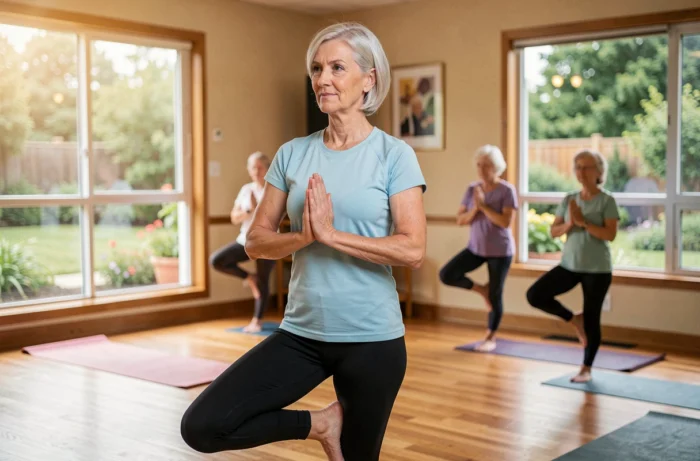
Maintaining a regular rhythm of activities after retirement is not a luxury. It is a direct lever on physical health, intellectual vitality, and the quality of social relationships. However, it is essential to choose practices that correspond to one’s actual capabilities, not to an idealized image of the “dynamic senior.” Here are some concrete suggestions, categorized by what they truly bring to daily life.
Fall Prevention: The Most Important Activity After 65
Before discussing yoga, painting, or book clubs, one topic deserves to be addressed first. Falls remain the leading cause of domestic accidents among the elderly. And the answer does not necessarily involve a specific sport.
The High Authority of Health places adapted physical activity at the heart of fall prevention. The principle: combine balance exercises and muscle strengthening in a regular program. Walking every day is not enough if stabilizing muscles are never engaged.
In practice, this can take the form of workshops led by a trained professional, often offered by CCAS or health centers. In Tours, for example, the CCAS organizes adapted physical activity sessions combined with outings to regain confidence in transportation. This type of program varies by region: a call to your local municipality can help identify activities suitable for seniors available nearby.
The choice of activity matters less than the regularity and the combination of balance and strengthening. A person who does three short sessions per week combining these two components significantly reduces their risk, regardless of the chosen exercise.
Daily Movement: Why Gardening and Housework Matter as Much as Gentle Gym
The World Health Organization recommends that older adults combine endurance, muscle strengthening, and balance exercises. But it also specifies that gardening or walking contributes to moderate activity just as much as a structured session.
Have you noticed that some very active people in their gardens never set foot in a gym and are doing just fine? It’s not a coincidence. Reducing sedentary behavior starts with integrating movements into daily life: climbing stairs, carrying groceries, digging a patch of soil.
The nuance is here: “physical activity” and “sport” do not mean the same thing. Sport involves a structured framework, rules, often performance. Physical activity encompasses any movement that increases energy expenditure. For a senior resuming after a period of inactivity, starting with daily movement is more realistic and sustainable than enrolling directly in a class.
- Gardening for 30 minutes engages the upper limbs, back, and balance without requiring special equipment.
- Walking at a brisk pace on a daily route (errands, visiting a neighbor) easily replaces an endurance session.
- Doing housework while standing, with wide movements, mobilizes joints and maintains flexibility.
The goal is not to turn every gesture into exercise, but to recognize that integrated movement in daily life protects just as much as a formal program.
Cognitive Stimulation: Writing Workshops, Strategy Games, and Digital Learning
Keeping the mind sharp is not limited to morning crosswords. Several workshop formats allow for working on memory, reasoning, and creativity, while also fostering social connections.
Writing workshops, for example, engage autobiographical memory, vocabulary, and idea structuring. Writing a short text each week encourages organizing thoughts, searching for the right word, and proofreading. It’s a comprehensive exercise, accessible even without literary experience.
Strategy games like chess, bridge, or scrabble stimulate planning and anticipation. These cognitive functions are among the first to decline with age. Practicing them in a group adds a social dimension that enhances motivation.
Why not also consider digital learning? Using a tablet, sending an email, navigating a library website: these skills reduce isolation and open access to other activities (video conferencing with family, online registration for workshops). Some municipalities offer free introductory sessions in libraries or public digital spaces.
Social Connection and Collective Activities: The True Driver of Well-Being
You can practice the best gymnastics in the world: if you are isolated, the effect on your morale will remain limited. Social connection is the factor that transforms an activity into a source of fulfillment.
Volunteering illustrates this idea well. Donating time to an association, helping children with school reading, or participating in a food distribution structures the week, provides a role, and creates regular relationships. It is neither sport nor cognitive stimulation in the strict sense, but the impact on mental health is documented.
Cultural outings play a comparable role. Visiting an exhibition, attending a concert, or a screening organized by a local club combines physical movement, sensory stimulation, and interaction with others.
- Book clubs offer a regular meeting around a book, with discussion and discovery of new authors.
- Choirs or singing workshops work on breath control, memory of lyrics, and group coordination.
- Shared meals organized by some CCAS help break food isolation while creating connections.
Physical activity can also be part of a coordinated care pathway with the attending physician, not just a leisure program. Discussing desires and limits with your doctor can help direct you to suitable and sometimes covered options.
Finding the right activity often requires some trial and error. A workshop that appeals to a neighbor may not necessarily suit you. The most reliable criterion remains the pleasure felt after the session, not during registration. Testing two or three different formats over a month gives a clear idea of what is sustainable in the long run.


