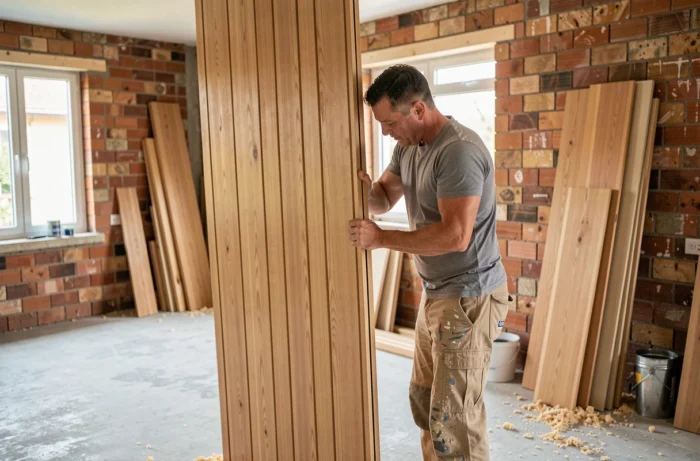
When renovating an interior or building with a wooden frame, the classic reflex is to install BA13 everywhere. This reflex has its reasons: drywall remains inexpensive and quick to implement. However, its limitations quickly become bothersome as soon as one seeks better impact resistance, adequate acoustic insulation, or a more durable finish.
Complete wall system: the real criterion before choosing a material
Before comparing panels, one point deserves your full attention. Performance depends on the complete system, not just the panel alone. A fiber-gypsum board installed on a simple metal rail will not provide the same acoustic insulation as the same board mounted in two layers on an appropriate frame.
The manufacturer Fermacell specifies that certain fire resistance performances are only achieved with specific two-layer installations. Therefore, comparing a wooden panel to a plasterboard without considering the rest of the wall (insulation, frame, number of layers) makes little sense.
Have you ever noticed that a drywall wall sounds hollow when you tap on it? It’s not just the panel that’s to blame: it’s often the absence of insulation in the plenum and the type of installation that explain this disappointing result. For those looking for an alternative to drywall for ceilings or walls, thinking in terms of a complete system avoids many disappointments.
Fiber-gypsum boards for walls and ceilings: strength and versatility
The fiber-gypsum board (of which Fermacell is the most well-known brand) combines gypsum and compressed cellulose fibers. The result is a panel that is significantly denser and harder than standard BA13.
Why this material changes the game daily
You can screw directly into the panel to attach a shelf, without special anchors or reinforcements. This is a concrete advantage that standard drywall cannot offer: hanging a kitchen cabinet or a heavy radiator on BA13 remains a puzzle of fixings.
The fiber-gypsum board is also used for bracing a wooden frame, provided that the manufacturer’s installation guidelines are followed. This dual use (interior finish and structural function) simplifies the construction site and reduces the number of materials to manage.
Limitations to be aware of
The weight per panel is significantly higher than that of BA13. Cutting generates more dust. And the cost per square meter remains higher than that of standard drywall. For a false ceiling, the added weight requires checking the capacity of the hangers and the frame.
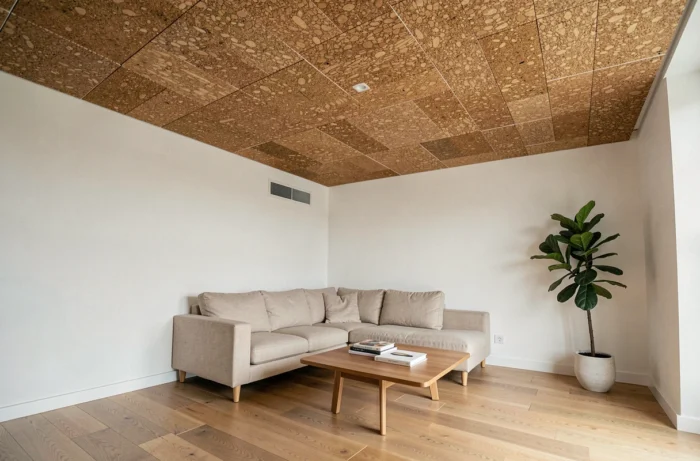
Wood paneling and boards: a finish without plaster for the ceiling
Why is this choice often made in renovation projects? Because wood paneling eliminates two tedious steps: plastering and sanding. The slats are fixed to battens or laths, and the finish is immediate.
Paneling is particularly suitable for ceilings under attics where a warm look is desired without spending hours smoothing joints. On walls, it also works as a wainscot or full cladding, depending on the desired style.
- Solid wood (pine, spruce, douglas fir) offers good moisture regulation and ages well in ventilated rooms.
- OSB panels (oriented strand board) are an economical option for technical rooms, with a raw aesthetic.
- Wood fiber panels also provide insulating function, which reduces the overall thickness of the wall.
The main constraint of wood on the ceiling is treatment in humid rooms. Untreated paneling in a bathroom will eventually warp. In these cases, a waterproof panel or another material would be preferable.
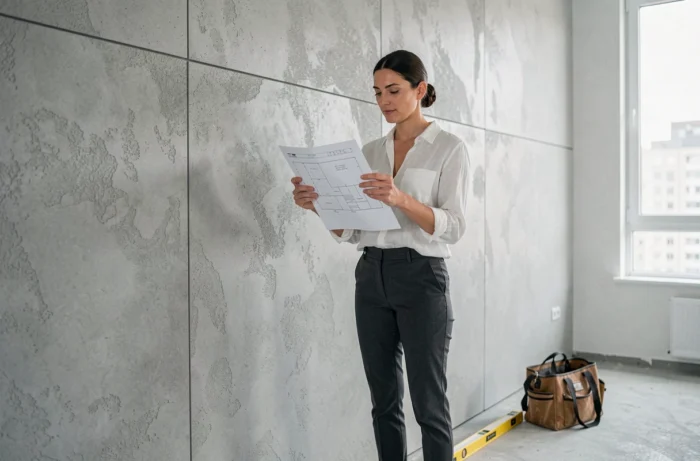
Earth and lime plasters: an alternative to drywall on masonry walls
On stone, brick, or rammed earth walls, installing drywall means enclosing a breathable support behind a vapor-tight barrier. An earth or lime plaster allows the wall to naturally regulate indoor humidity.
The earth plaster consists of clay, sand, and plant fibers. It is applied in several layers on the support, without metal framing or added insulation. Lime plaster works similarly, with a higher surface hardness.
These solutions are not suitable for all projects. They require a stable and flat support, or significant preparation work. On a wooden frame or new concrete blocks, a direct earth plaster is generally not suitable without a specific bonding layer. But on older buildings, it is often the most coherent response.
Removal of existing drywall: sorting plaster waste
When replacing drywall with another material, it is necessary to anticipate waste management. Plaster constitutes a distinct waste stream that should not be mixed with mineral debris. Mixing plaster and debris compromises the recycling of both streams.
This point impacts the budget and organization of the project. Planning separate bins or an appropriate collection point avoids refusals at the waste disposal site. This is a hidden cost of replacement that many homeowners discover too late.
The choice of a replacement material should also consider its end of life. Fiber-gypsum boards follow a recycling stream similar to that of plaster. Untreated solid wood can be repurposed for compost or energy. Earth plasters can be reused almost indefinitely, simply by rehydration.
Each alternative to drywall addresses a specific context: type of support, room concerned, humidity constraints, mechanical requirements. The best approach remains to first define the complete wall system, then choose the finish that integrates into it, rather than replacing one panel with another without rethinking the whole.


