In France, personal or professional relationships are the channel most likely to lead to a successful hire, accounting for 27% of cases according to Dares, ahead of unsolicited applications. The same applies to business opportunities: partnerships, contracts and referrals often come through an existing contact. Building a strong professional network is not a matter of social talent, but a methodical practice developed over time.
Weak ties and professional networks: why your more distant contacts matter more than you think
The natural instinct is to reach out to close friends, former direct colleagues or regular partners. A study published in the journal Science in 2022, based on experiments conducted via LinkedIn, found that weak ties promote career mobility. These less frequent contacts, sometimes met at a single event or during a one-off exchange, move in circles different from yours and share information that your immediate circle cannot access.
Business opportunities follow the same logic. A former classmate who has moved into another industry, a speaker you met at a conference, a service provider you worked with just once: these people have early insights into markets, tenders or emerging needs. Exploring the Contact Job professional website helps you identify profiles and industries beyond your usual circle, effectively broadening your prospecting reach.
The value of these weak ties nevertheless varies by industry. In highly specialized fields (biotechnology, niche engineering), a close-knit network remains crucial because technical knowledge circulates within a small circle. In sales or service industries, the diversity of contacts matters more than how close they are.

Social selling and professional communities: going beyond connection requests
Sending a LinkedIn invitation with a generic message is not networking. Social selling, as practiced in today’s B2B strategies, relies on regularly contributing to discussions in your industry. Commenting on a post with a technical analysis, sharing practical lessons from a project, answering a question in a professional group: these interactions build familiarity before a business relationship begins.
Online communities (themed LinkedIn groups, industry forums, professional Slack channels) serve as spaces for mutual pre-qualification. Members can assess your expertise before you even contact them. A business leader who regularly posts about issues in their field receives inbound inquiries instead of having to cold-prospect.
In-person events and networking: what works in practice
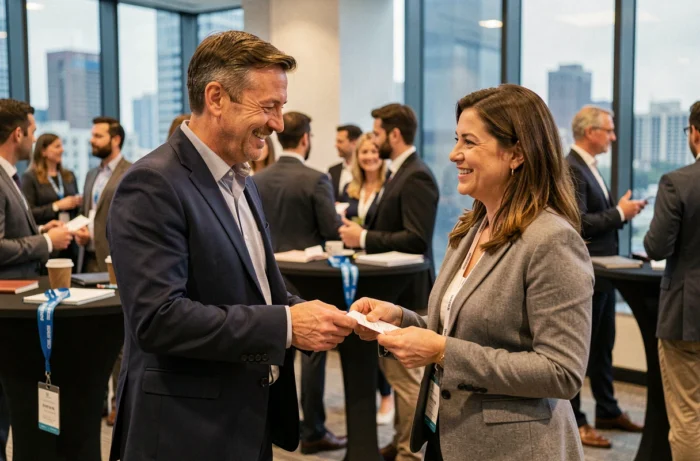
Trade shows, conferences and business breakfasts remain the places where relationships form most quickly. A handshake, an informal chat during a break, a conversation after a panel discussion: these create a level of trust that digital interactions cannot replicate as quickly.
For attending an event to deliver results, three conditions must be met:
- Prepare a list of attendees or speakers you want to meet in advance, checking their work and current priorities so you can start a focused rather than general conversation
- Follow up within 48 hours of the event with a personalized message that recalls the context of your meeting, not a standardized copy-and-paste note
- Offer something concrete (a relevant article, an introduction, practical insights) rather than immediately asking for a sales meeting
B2B prospecting and professional networks: GDPR requirements to know
Building your network also involves direct prospecting, where a frequently overlooked regulatory requirement comes into play. Professional data is still personal data under the GDPR. The fact that a LinkedIn profile is public or an email address appears on a company website does not mean those details can be freely extracted and reused.
The CNIL allows B2B prospecting to rely on legitimate interest without prior consent, but only under specific conditions. The message must be relevant to the professional role of the person being contacted. An email sent to a sales director offering them a sales management tool falls within this scope. The same email sent to an HR manager does not.
Automated scraping: an underestimated risk
Several tools promise to automatically extract contacts from professional social networks. Recent CNIL decisions make clear that this practice can lead to penalties if it fails to meet transparency and right-to-object requirements. A prospecting database built through scraping without a solid legal basis can result in fines and damage the company’s reputation among the people targeted.
The practical challenge lies in traceability: you must be able to show where each contact came from, the legal basis for adding them to the database, and how they can exercise their rights. For small businesses building their professional networks through digital prospecting, documenting this compliance process requires a significant investment of time.

Maintaining professional contacts: the frequency that delivers results
Building a contact list is not enough. A network that is not maintained loses its value within a few months. The challenge is finding the right balance: too many messages become tiresome, while too few can make you fade from memory.
A practical approach is to divide your contacts into three groups:
- Active contacts (partners, clients, regular referrers) to whom you provide value at least once a month through a conversation, sharing content or making a referral
- Dormant contacts to reconnect with once or twice a quarter, by commenting on news in their industry or a change in their role
- Distant contacts (one-off acquaintances, former classmates) to whom a brief annual message can maintain the connection without pressure
Professional networks generate opportunities in proportion to the attention you invest in them, not the number of messages you send. A thoughtful comment on a post, an article shared because it directly relates to a contact’s work, an introduction between two people in your network: these gestures take little time and build a reputation as a reliable connector, ultimately attracting business opportunities instead of forcing you to chase them.


