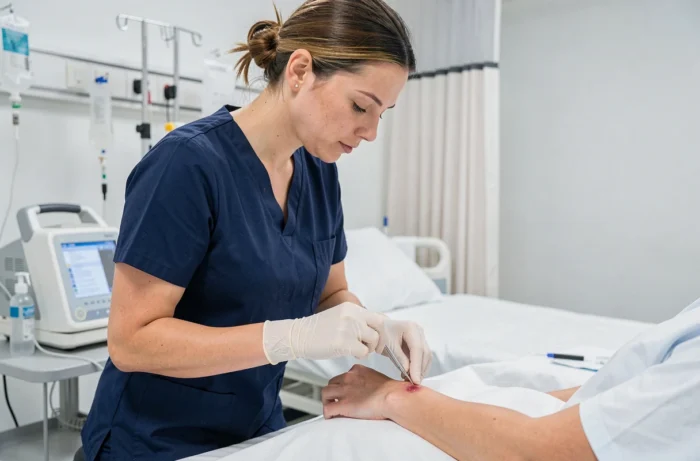
Since the decree of June 26, 2026, the list of care tasks that a nursing assistant may perform has been formally set out in regulations. This text does not grant general autonomy: it defines the tasks that nurses may delegate as part of their own professional role, distinguishing between two groups of care based on the professionals authorized to perform them. For nursing assistants who qualified before 2021, this change means updating their practices in concrete ways.
Two distinct groups of care in the June 2026 decree
The structure of the text is based on a distinction that training providers rarely explain in detail: not all delegable tasks are open to the same categories of professionals. The decree separates them into Group A and Group B, each with its own conditions for carrying out tasks and its own authorized professionals.
Group A includes, in particular, collecting observable data using non-invasive methods and identifying behavioral changes. Group B covers other activities, including assisting with the administration of non-injectable medication. This division means that nursing assistants must check, task by task, whether they belong to the category authorized to perform it.
Medication is the most common source of confusion. Checking that a patient has taken medication (Group A) is not the same as assisting them to take it (Group B). The former means making sure the patient has taken the medication prepared by the nurse.
The latter involves providing physical assistance. This distinction may seem slight, but it entails different responsibilities. A nursing assistant who confuses the two acts outside the scope authorized for their category, with the resulting legal consequences.
Understanding the new 2026 nursing assistant decree and framework makes it possible to identify the correct group for each task and avoid these misinterpretations.
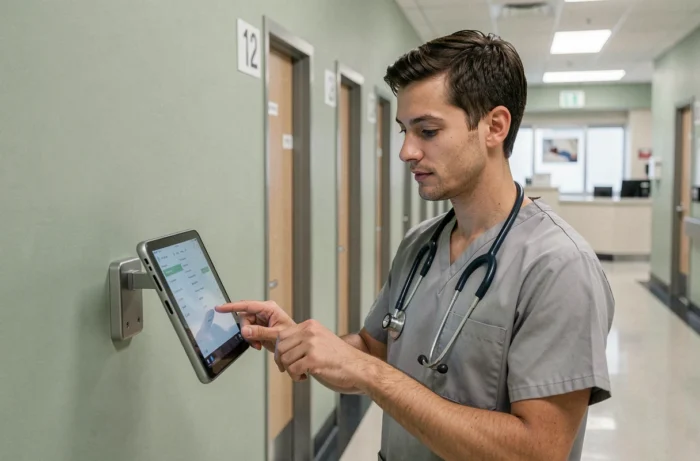
Technical procedures under a nursing protocol: what nursing assistants can do
The framework established by the decree does not give nursing assistants free rein. Each technical care task is still delegated by the nurse, who remains responsible, as part of their own professional role. Nursing assistants must never initiate a procedure on their own: they carry out care after the nurse has made a decision and, where applicable, established a protocol.
Among the tasks now formally defined, three categories account for most of the practical changes:
- Collecting clinical data using non-invasive methods (temperature, blood pressure, oxygen saturation), provided the nursing assistant reports the results and flags any abnormalities without interpreting them.
- Preventing pressure sores, including skin checks, repositioning, and the use of appropriate support surfaces in accordance with a written protocol.
- Identifying behavioral changes in older people or people with disabilities, with a requirement to provide structured updates to the coordinating nurse.
These tasks were often already part of day-to-day practice, but informally. The difference in 2026 is that they are now listed and regulated, and carrying them out without a protocol may expose both the nursing assistant and the facility to liability.
Clinical reasoning and cross-disciplinary skills at Bac level
The training framework introduced by the decree of June 10, 2021, and strengthened by the 2025 regulations, raised the nursing assistant qualification to Level 4 (equivalent to the French Baccalaureate). This is more than a cosmetic change: it reflects the integration of clinical reasoning into the core competencies expected of nursing assistants.
For a nursing assistant, clinical reasoning does not mean making a diagnosis. It involves observing a range of signs in the person receiving care, relating them to that person’s usual condition, and communicating relevant information. This skill requires analytical ability that was not formally included in the 2005 framework.
In practice, a nursing assistant trained under the new framework can distinguish a temporary change in behavior from a warning sign that requires prompt intervention. Observation becomes a structured professional task, not simply a passive observation reported verbally at the end of a shift.
Supervising trainees on placement
The framework now includes the ability to welcome, support, and assess a nursing assistant trainee on placement. This mentoring role, once reserved for nurses or managers, is now part of the expected scope of practice. It requires teaching skills: giving factual feedback on observed practice, identifying areas for improvement, and adapting support to the trainee’s level.
Mandatory updates for nursing assistants who qualified before 2021
Nursing assistants trained under the October 2005 framework are not automatically familiar with the tasks and clinical reasoning described in current regulations. Several facilities offer refresher training, generally lasting three days, to cover the differences between the old and new frameworks.
This training focuses on four main areas:
- Redefining the nursing assistant’s duties and scope of practice under the current framework.
- Developing a reflective approach to care situations through the analysis of real-world cases.
- Identifying risks when supporting patients (falls, choking, and skin deterioration).
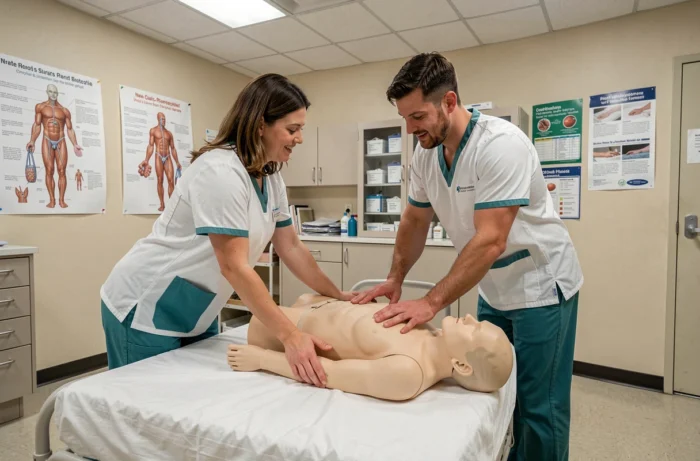
- Practicing new technical procedures under protocol through simulated scenarios.
This refresher training is more than a simple theoretical review. It aims to change professional habits formed under a regulatory framework that has since changed. Nursing assistants who continue to work within the boundaries set in 2005 may be found to have deviated from current practice during an audit or following an adverse event.
The move to Level 4 and the formal definition of delegable tasks are reshaping a profession that now relies more heavily on structured clinical communication than on carrying out prescribed tasks. For nursing assistants currently in practice, carefully reviewing Groups A and B in the decree remains the first step to take before performing any task.


