
A move to a smaller apartment, a change in eating habits with more fresh products, or simply an old fridge breaking down in the middle of summer: the choice of a refrigerator is rarely made in the abstract. We choose it for a specific use, a given space, and eating habits that we already know. It’s better to start from these concrete constraints rather than a list of technical specifications.
Actual refrigerator temperature: what the displayed setting does not guarantee
Most appliances allow you to set a temperature, often between 3 and 5 °C. You set it and forget it. The problem is that the actual temperature inside varies depending on the area of the fridge, the frequency of door openings, and the food load.
For highly perishable products (raw meat, fish, opened dairy products), the recommendation is to place them in the coldest zone, at 4 °C or lower. An independent thermometer placed in the main compartment remains the only reliable way to check that the appliance lives up to its promise, especially after installation or during periods of high heat.
We often compare two refrigerators based on their volume or energy class, but we gain more by comparing their thermal consistency. An appliance that fluctuates several degrees between two compressor cycles preserves food less effectively than a stable model, even if the displayed setting is the same. This point is rarely mentioned on product sheets, yet it is the one that determines the actual shelf life of fresh food.
To delve deeper into the technical characteristics of different models, a useful resource is: https://www.monfrigo.net/, which allows you to compare appliances based on concrete criteria.
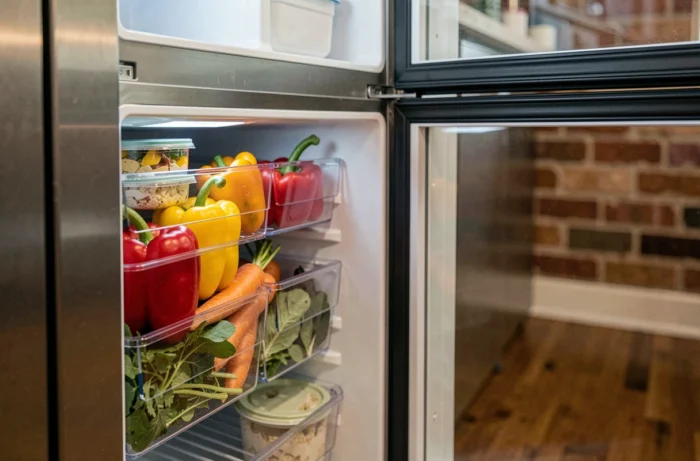
Static, mixed, or ventilated cooling: choose based on what you really store
Buying guides extensively detail the three cooling technologies. In practice, the choice mainly depends on what you put in your fridge on a daily basis.
Static cooling for small volumes
Cold air naturally descends, creating different temperature zones between the top and bottom of the appliance. This operation is suitable for small refrigerators for one or two people, where the contents are consumed quickly. The downside: frost forms on the back wall and requires regular defrosting, or else it leads to overconsumption.
Mixed cooling for versatile use
A fan distributes the cold air more evenly. The temperature differences between zones decrease, which improves the preservation of fruits and vegetables stored at different levels. It’s a good compromise for a household of three or four people who regularly cook with fresh products.
Ventilated cooling (no frost) for large volumes
Ventilated cooling eliminates frost formation and maintains a uniform temperature throughout the appliance. It becomes almost necessary in large combined refrigerators or multi-door models, where large volumes amplify thermal discrepancies. In return, dry air can dehydrate certain unpackaged foods, especially leafy vegetables.
- Static cooling: suitable for small appliances, low-cost but requires regular frost maintenance
- Mixed cooling: good balance for medium households, reduces temperature differences without drying out
- Ventilated cooling (no frost): efficient for large volumes, eliminates frost but requires protecting sensitive foods from drying out
Reparability of the refrigerator: a purchasing criterion that has become regulatory
We rarely think about breakdowns at the time of purchase. The refrigerator is, however, one of the appliances that runs continuously, and a failure of the compressor or thermostat after a few years raises a simple question: repair or replace.
The European eco-design regulation applicable to refrigeration appliances mandates the availability of certain spare parts for several years and access for professional repairers to repair information. Member states must implement the directive on the right to repair by July 31, 2026.
In practice, before buying, you can check if the brand has a network of authorized repairers nearby and if common parts (door seal, thermostat, handle) are listed in their online catalog. A repairable refrigerator costs less over ten years than a disposable model bought at a discount.

Usable volume and door configuration: starting from the available space
Standard recommendations on the necessary volume per person are often read. They provide a rough estimate, but the real starting point remains the niche available in the kitchen, or the floor space if the appliance is freestanding.
Measuring the width, depth (including space for rear ventilation), and available height allows you to immediately eliminate unsuitable formats. A large combined model is useless if it prevents you from opening a neighboring cupboard.
- Tabletop refrigerator: compact, suitable for studios or as a supplementary unit, limited volume
- Combined (refrigerator + freezer): the most common format, available as freestanding or built-in
- Multi-door or side-by-side: large volumes, require a width of at least 80 to 90 cm and a water connection for models with a dispenser
The door configuration also affects internal organization. A model with French doors and a freezer drawer at the bottom facilitates access to fresh food on a daily basis, while a classic combined model with a top freezer is better if you freeze a lot and want to access it without bending down.
The choice between built-in and freestanding depends as much on the desired aesthetics as on the budget: a built-in model integrates into the kitchen, but the dimension constraints often impose a lower usable volume than that of a freestanding model of the same external size.
The refrigerator that we keep the longest is the one that matches both the actual space of the kitchen, the type of food we store there each week, and the possibility of having it repaired locally. These three criteria, taken together, eliminate the majority of poor choices much more effectively than a technical sheet read in-store.


