
The French fitness club market has more than six million members, according to data from Union Sport et Cycles. Commercial gyms are becoming a leading setting for physical activity, according to the 2025 National Sports Participation Barometer from INJEP and CRÉDOC.
Even so, half of new members leave their gym within six months, according to IHRSA figures. This gap between initial enthusiasm and rapid dropout raises a practical question: what criteria should you use to make a choice that lasts, especially if your goals include building muscle, losing weight or getting back in shape?
Contracts and cancellations: what the law requires before you sign up
Before comparing a club’s equipment or atmosphere, take a close look at the contract. Most guides skim over this point, even though it determines how much flexibility you have once you’ve signed up.
Since 1 June 2023, any club that allows members to sign up online must offer free online cancellation. This requirement applies to the cancellation method, not the membership term or notice period. A membership with a 12-month commitment remains valid even if you can cancel it with one click.
Early cancellation terms vary from one contract to another. Moving house or sustaining an injury does not automatically entitle you to cancel without a fee. The Commission des clauses abusives reviewed industry practices in its Recommendation No. 24-01 of 3 July 2024. Checking which reasons are accepted and what supporting documents are required before signing can help you avoid unpleasant surprises three months later.
Check these three points in the contract:
- The minimum commitment period and the amount of monthly payments remaining if you leave early without an accepted reason.
- How to cancel (online, by registered mail, or both) and the applicable notice period.
- The terms for freezing or temporarily suspending your membership, which can be useful if you’re going away for an extended period or are injured.
A no-commitment membership often costs a few euros more per month. Browse men’s gyms on L’Esprit du Sport to compare membership options and find those that offer this flexibility.
Strength-training equipment and workout areas: what makes the difference
A well-equipped gym is about more than rows of machines. For anyone looking to build muscle or get stronger, a free-weights area with Olympic barbells, dumbbells and squat racks can make a real difference to workout quality. Machines complement your training, but free weights engage more muscles and help you develop technique in ways that cable machines alone cannot.
The ratio of members to workout stations matters more than the gym’s overall floor space. A spacious but crowded gym at peak times may force you to change your programme or wait between exercises, disrupting your rhythm and making your workout longer.
Check it out in person, not on Instagram
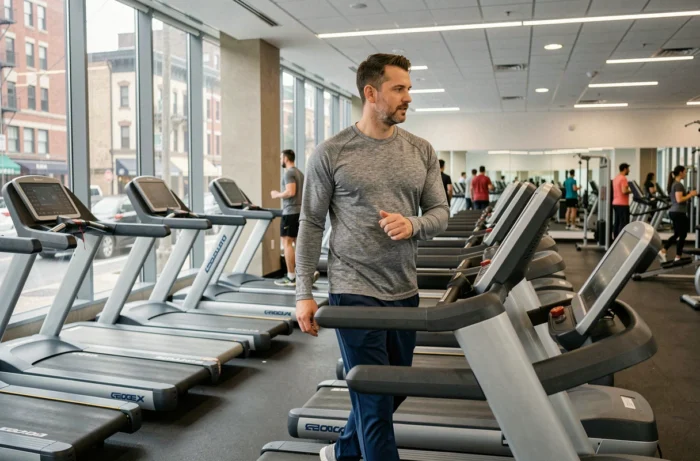
Promotional photos rarely show what the gym looks like at 6:30 p.m. on a Tuesday. The best test is to ask for a trial session at the times you plan to work out. Check the condition of the equipment, ventilation and changing rooms. Visiting during peak hours shows you what no guided tour can.
The 2025 National Sports Participation Barometer notes that independent workouts (at home, outdoors or using apps) remain popular. Comparing a gym not only with other clubs but also with what you could do at home with minimal investment can help you set a realistic budget. If your main goal is cardio, an expensive membership is harder to justify than it would be for a strength-training programme that requires heavy weights.
Coaching and group classes: assess the support on offer
According to IHRSA data, 87% of members who have a positive onboarding experience remain active after six months. Support when you get started—an initial assessment, a personalised programme and help with your form—is a measurable factor in maintaining a regular routine.
Not all clubs offer the same level of coaching. Some include one or two sessions with a coach in the membership fee, while others charge for each session. For beginners in strength training, technical guidance during the first few weeks reduces the risk of injury and helps you learn fundamental movements faster, including squats, deadlifts and bench presses.
Group classes such as circuit training, HIIT and functional strength training provide structure and consistency that solo workouts don’t always offer. Check the actual timetable: a club that advertises 30 classes a week but schedules most of them in the middle of the morning won’t suit someone who works during the day.
Lifestyle and location: the factor confirmed by dropout rates
Being close to home or work remains the factor most closely linked to consistency. A journey of more than 20 minutes can become a barrier once your initial motivation fades. Choose the gym closest to your daily route, not the best-equipped one across town.
Opening hours deserve the same scrutiny. A gym open from 6 a.m. to 11 p.m. offers more flexibility than one that closes at 9 p.m., especially if you prefer to work out early in the morning or late in the evening. Budget chains often offer extended opening hours, sometimes with 24/7 access, which can make up for less hands-on support.

Que Choisir’s gym satisfaction survey and reviews on rating platforms can help you compare commercial promises with members’ actual experiences. Recent reviews of cleanliness and equipment availability matter more than the overall rating.
Choosing the right gym depends less on the advertised price than on how well the contract, equipment, coaching and practical considerations suit your needs. Visiting at the times you would actually work out, reading the cancellation terms in full and trying the coaching on offer are enough to help you choose between two competing clubs. The rest comes down to consistency—and consistency starts with an environment that makes life easier.


