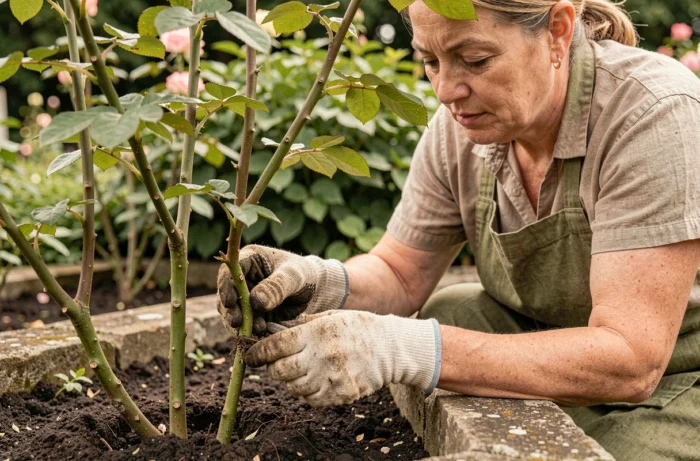
Grafted rose bushes regularly produce shoots from the rootstock, known as suckers. These stems divert sap from the cultivated variety, gradually reducing flowering. Removing them requires a precise touch: a poorly placed cut or mistaking a basal shoot from the scion for a sucker can weaken the rose bush rather than strengthen it.
Grafted or own-root rose: the diagnosis to make before taking action
Before removing a single stem, first determine what type of rose you have. On an own-root rose, every basal shoot belongs to the cultivated variety. Pulling one out would remove a stem that helps renew the plant.
With a grafted rose, the situation is different. The rootstock (often a dog rose) can produce vigorous shoots that compete directly with the scion. Only these shoots are true suckers.
Three clues can help you tell whether a rose is grafted: the purchase label, a visible swelling at the base of the stem (the graft union), or the plant’s history. If you cannot identify a graft union, proceed with caution. Routinely removing basal shoots from an own-root rose deprives it of its natural ability to regenerate. Before removing suckers from a rose bush, this check is the only way to ensure you do not weaken the plant.
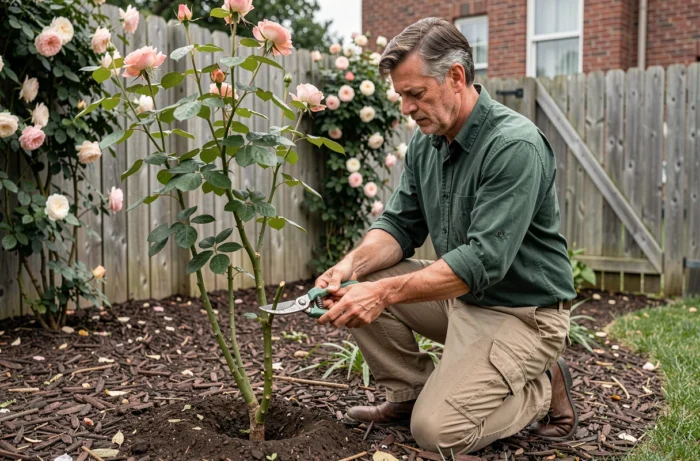
Identifying a sucker on a grafted rose: look beyond the number of leaflets
The rule repeated everywhere is to count the leaflets: five on the scion, seven on the sucker. This can be misleading. Many cultivated roses naturally have leaves with seven leaflets, while some rootstocks produce leaves with five.
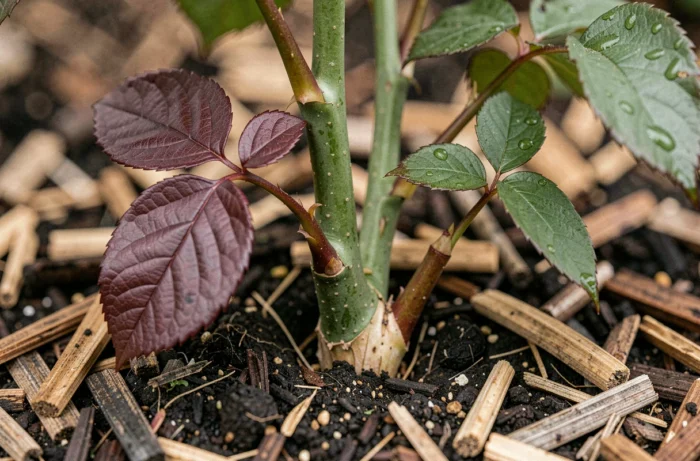
The most reliable clue is where the stem starts. Follow the suspect shoot down to its base and check whether it emerges below the graft union. If it does, it comes from the rootstock and is a sucker. If it emerges above the graft union, it belongs to the scion and should be kept.
Other clues to consider
Foliage can still help guide your assessment, provided you compare it with other features:
- Wood color: dog rose suckers are often lighter, tending toward pale green, while the scion’s wood is darker or tinged with red, depending on the variety.
- Thorn shape: the rootstock often produces numerous fine prickles that differ from those on the scion.
- Growth habit: a sucker grows very straight and very quickly, often rising above the rest of the plant within a few weeks.
None of these clues is conclusive on its own. It is their combination, confirmed by the shoot’s position below the graft union, that establishes the diagnosis.
Removing a rose sucker without encouraging regrowth
The most common method is to cut the sucker off at ground level with secateurs. This leaves its point of origin on the rootstock root intact. Within a few weeks, one or more new shoots may grow from the same spot.
For lasting removal, clear the soil around the base of the shoot and pull it off sharply at the point where it joins the root. This removes the dormant bud it grew from, greatly reducing the risk of regrowth.
When suckers emerge some distance from the plant
A sucker does not always emerge at the base of the stem. It can appear several dozen centimeters from the trunk, growing from a spreading root of the rootstock. Cutting it at the surface will not solve the problem: the root remains intact and can produce more shoots.
In this case, follow the shoot underground to the root it came from. Carefully clear the soil without damaging the scion’s main roots, then cut the shoot as close as possible to the root it is growing from. It is best to do this in spring or early summer, when the soil is loose and the shoots are still young.
When to prune suckers and common mistakes to avoid
Suckers appear mainly from spring through late summer, when sap is flowing strongly. Removing them early, while they are less than about 20 centimeters long, makes them easier to pull out and reduces stress on the rose.
Waiting until a sucker becomes woody makes removal more difficult. A hardened shoot requires a sharp tool and may damage the graft union when pulled out. The wound heals more slowly, leaving the plant vulnerable to pathogenic fungi.
Mistakes to avoid
- Mistaking a vigorous basal shoot from the scion for a sucker. Vigor alone is not enough to identify a sucker. Only its origin below the graft union confirms it.
- Using secateurs without disinfecting them. Cuts at the base of the stem are vulnerable to fungal infections, especially canker.
- Covering the area with soil immediately after pulling out a sucker. Leaving the wound exposed to the air for a few hours allows it to begin healing before you replace the soil.
- Ignoring shoots growing away from the plant because you assume they are self-sown seedlings. Always check whether the stem is connected to a root from the rootstock.
When suckers are removed correctly and at the right time, the rose bush can direct all its sap toward flowering on the scion. How you remove them matters as much as when: pulling them out cleanly in spring saves the rose unnecessary energy loss and protects the integrity of its root system.


