
Measuring the dominance of an operating system starts with defining the scope. In June 2019, the rankings changed dramatically depending on whether you looked at all connected devices, desktop computers only, or smartphones alone. This distinction, rarely made explicit, changes how market shares are interpreted—and even what “dominance” means.
All devices, desktop or mobile: three different rankings in June 2019
Web traffic data compiled by tools such as StatCounter does not produce a single ranking. Usage is broken down by device type, resulting in three distinct hierarchies for the same month: June 2019.
On desktop computers, Windows maintained an overwhelming lead, driven by Windows 10 and earlier versions that were still widely used in businesses. macOS ranked second, far behind, followed by Linux distributions, whose share remained marginal.
On mobile, the picture was reversed. Android accounted for the majority of global traffic, relegating iOS to second place. Windows, virtually absent from smartphones since Windows Phone was discontinued, had no meaningful share in this segment.
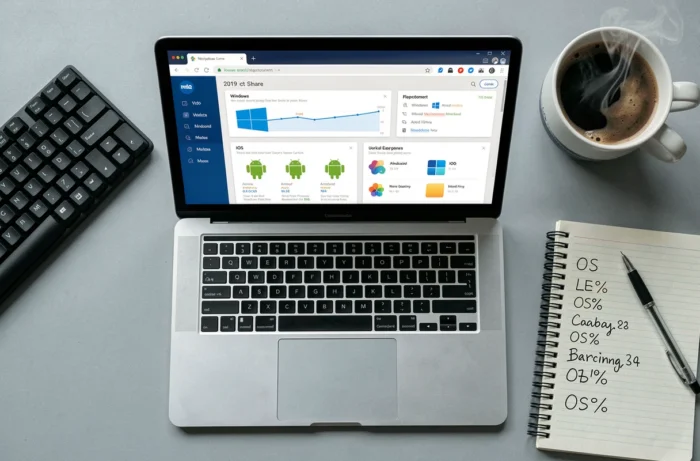
The 2019 operating system rankings reflect these differences depending on the scope used. When all devices were combined, Android overtook Windows worldwide simply because mobile connections outnumbered desktop connections.

Desktop market shares in June 2019: Windows, macOS, Linux
The desktop segment remained the most concentrated. Windows reigned unchallenged across all versions. Windows 10 had gradually absorbed the Windows 7 installed base, although the latter was still used across a significant share of computers, particularly in government agencies and small and medium-sized businesses that were delaying migration.
| Operating system | Desktop segment (June 2019) |
|---|---|
| Windows (all versions) | Overwhelming majority |
| macOS | Second place, minority share |
| Linux | Very small share, a few percent |
| Chrome OS | Negligible presence outside the US education market |
macOS was growing slowly but steadily, driven by MacBook upgrades among creative professionals and in the tech industry. Despite its active community, Linux remained largely confined to server use and technical users.
Chrome OS, often overlooked in these rankings, had a meaningful presence only in the US education market. In France, its desktop presence was virtually nonexistent.
Global mobile market: Android vs. iOS in June 2019
The mobile segment told a very different story. Android dominated global mobile traffic, with a comfortable lead over iOS. Several factors explain this gap:
- The wide range of manufacturers using Android (Samsung, Huawei, Xiaomi, Oppo, and dozens of others) created multiple entry points into the market, from smartphones costing under one hundred euros to high-end flagships.
- iOS was limited to Apple’s iPhones, which were positioned at a higher price point. This mechanically reduced its user base in emerging markets (Asia, Africa, Latin America).
- Other mobile operating systems had disappeared or were on their way out: Windows Phone was no longer supported, Firefox OS had been discontinued, and Samsung’s Tizen was available on only a few entry-level models.
The breakdown also varied considerably by country. National figures reflected local dynamics shaped by purchasing power and consumer habits, with iOS benefiting from a loyal user base in high-income markets.
Why the scope of measurement changes what OS dominance means
Claiming that an operating system “dominated” in June 2019 without specifying the scope means comparing incompatible realities. Windows was hegemonic on desktop. Android was clearly ahead on mobile worldwide. And across all devices, Android took the lead thanks to the growing share of mobile traffic.
The shift to mobile was not new in 2019, but it had reached a point where mobile traffic was having an increasingly significant impact on aggregated rankings. The “all devices” ranking therefore reflected mobile usage more than desktop usage.
What this means for interpreting statistics
An IT decision-maker who read that “Android is the world’s leading OS” in June 2019 might have drawn the wrong conclusion about their company’s computer fleet, which consisted almost entirely of Windows machines. Conversely, a mobile app developer relying on the desktop ranking would have missed the reality of their users.
The scope determines the ranking, and neither leader (Windows on desktop, Android on mobile) had a serious competitor in its segment in June 2019. Dominance was shared, with each reigning over its own territory.
Data from this period also shows that macOS and iOS market shares remained stable, with no significant breakthrough. Apple consolidated its existing user base without gaining ground in new segments. Linux continued to grow on servers, a domain invisible in web browsing statistics, which measure client-side usage.
Relying on a single overall figure to sum up the operating system market in June 2019 therefore obscures the key point: two distinct ecosystems, two undisputed leaders, and a divide between desktop and mobile that aggregated rankings cannot capture.


