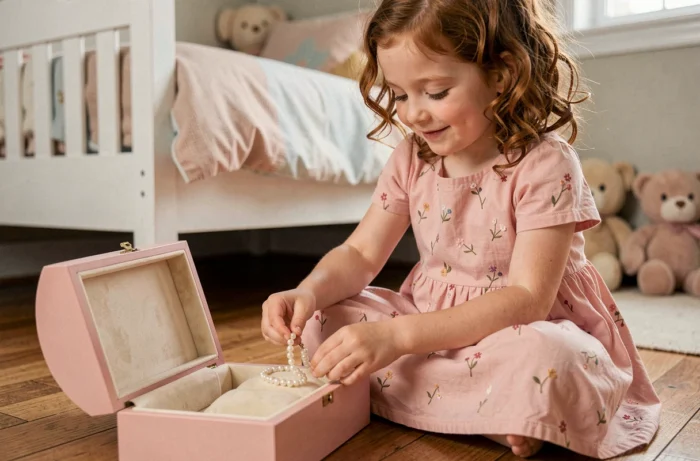
Choosing a gift for a child means picking from dozens of product categories, from toys and clothes to books. A children’s jewelry box stands out because it meets several criteria that rarely come together: everyday usefulness, sentimental value, a long lifespan, and suitability for a wide range of ages. Comparing these factors helps explain why this gift consistently earns high satisfaction.
Children’s jewelry boxes compared with other gifts: a criterion-by-criterion comparison
Four factors matter when assessing whether a gift is a good choice: how long it will be used, whether it can grow with the child, its perceived sentimental value, and the risk of disappointment, duplication, or rapid obsolescence. The table below compares a jewelry box with three types of gifts commonly given to children.
| Criterion | Jewelry box | Classic toy | Clothing | Illustrated book |
|---|---|---|---|---|
| How long it will be used | Several years (contents change over time) | A few months to a year | One growth season | Limited rereading over time |
| Adaptability to age | High: the child stores different items as they grow | Low: narrow age range | None: fixed size | Moderate: reading level stays the same |
| Sentimental value | High: personal keepsake | Varies by toy | Low | Moderate to high |
| Risk of duplication | Very low | High | Moderate | Moderate |
The biggest difference is in how long the gift will be used and the risk of duplication. Children rarely have two jewelry boxes, but can easily accumulate similar toys. The box’s contents change with their tastes: costume rings at five, their first silver bracelets at ten, and travel souvenirs as teenagers.
Giving a jewelry box for a child is therefore a way to choose an item whose usefulness won’t fade with a trend or a season.
Safety and materials: what regulations require you to check
Materials are about more than appearance. They directly affect safety, an aspect that most buying guides cover only superficially.
Toy or storage item: a regulatory distinction
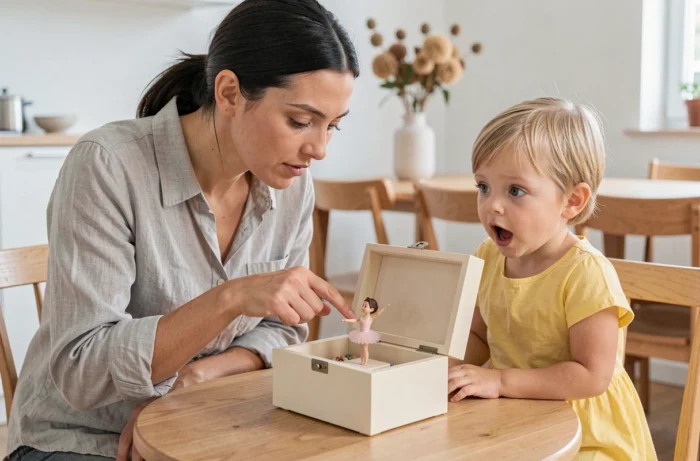
A jewelry box intended for a child under 14 may fall under toy safety regulations if it is designed or marketed as a plaything. Its classification depends on how it is presented and its features, not just its commercial name. A box sold as decorative storage does not automatically fall into this category.
Since December 13, 2024, the European General Product Safety Regulation has required manufacturers to consider children as vulnerable users, even for products that are not classified as toys. In practice, this means that easily detachable parts and closures that could pinch fingers must be avoided, regardless of the product category.
Materials to choose by age
- Unfinished or solvent-free lacquered wood: sturdy, impact-resistant, and suitable from age three or four. The box’s weight reduces the risk of it falling from a high shelf.
- Soft leather or faux leather: a practical travel option for older children, and less fragile than a rigid box in a backpack.
- Reinforced cardboard with a fabric covering: lightweight and easy to personalize, but less durable. A good choice for a toddler’s first jewelry box.
CE marking alone does not guarantee that a product is safe. It indicates that the manufacturer has declared the product compliant. Checking that the hinges are sturdy, there are no small removable parts, and the paints or varnishes are safe is still a useful step when buying.
Sentimental value: why a jewelry box becomes a keepsake
A toy breaks or goes out of fashion. Clothes are passed on when they become too small. A jewelry box, on the other hand, gathers layers of memories over the years. This role as a personal repository gives it greater sentimental value than most gifts.
At first, children put in treasures with no monetary value: a seashell, a fairground ring, a bracelet braided by a friend. Then the contents change. The first pieces of jewelry they receive for a communion, a milestone birthday, or the arrival of a new sibling find their place in the compartments. The box becomes a tangible record of important moments.
This explains why adults often keep their childhood jewelry box, even when it’s empty. Its emotional value comes not from the object itself, but from what it once held.
How to choose a children’s jewelry box for the occasion
Not every box is right for every situation. The choice depends on three factors: the child’s age, the occasion, and your budget.
For a birthday gift for a child aged four to seven, a wooden box with a mirror and fixed compartments is a good choice. The child can open it, put their things away, and close it without pinching their fingers. Its compact size makes it suitable for a bedside table or a small shelf.
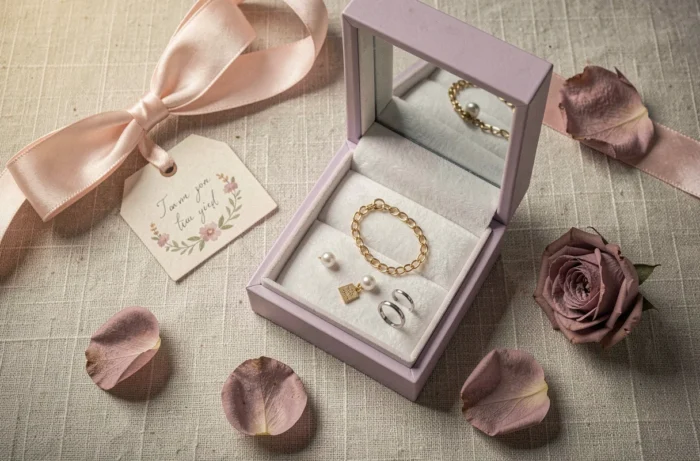
For a birth or christening, a simple, customizable box (with an engraved name or embroidered date) serves two purposes: an immediate gift for the parents and an item the child can make their own later. In this case, quality leather or fabric will age better than plastic.
For a child aged eight or older, a travel-friendly design (a zippered case or a compartmentalized pouch) is genuinely useful. The child can take their jewelry to a parent’s home, on vacation, or to a friend’s house. A portable box stays useful well beyond the bedroom.
Budget is not a deciding factor. Reinforced cardboard and simple wooden boxes are available at affordable prices, while leather versions and handcrafted designs sit at the higher end of the range. The price difference mainly reflects the material’s durability and the level of finish, not the thoughtfulness of the gift.
A children’s jewelry box remains one of the few gifts that is almost certain to please. It doesn’t depend on batteries, size, or fashion. It simply waits for something to be placed inside—and that is precisely what makes it such a special gift.


