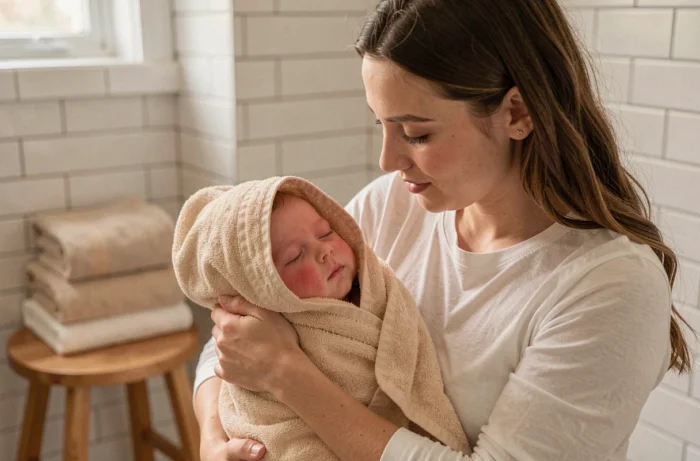
Bathing is a real physiological effort for an infant. Their body engages several systems at once to adapt to an environment that differs greatly from the surrounding air: water temperature, contact across the entire skin surface, unfamiliar positions, and amplified sounds. This explains why babies often become drowsy within minutes of getting out of the water.
Skin surface area relative to body weight: the factor parents underestimate
An infant has a much higher skin surface area-to-body weight ratio than an adult. Put simply, their skin is proportionally very large compared with their body mass. This imbalance has a direct consequence: heat exchange with the environment is substantial.
In bathwater, the skin transfers heat much faster than it does in air. A baby’s body must constantly adjust its heat production to maintain a stable internal temperature. This process of thermoregulation uses energy and continues long after the baby gets out of the water.
The process intensifies as soon as the baby gets out. Evaporation from wet skin speeds up cooling. The baby’s body must then make up for this heat loss by burning calories, which is an invisible but real effort. The longer drying and dressing take, the more energy the baby uses. An article explaining post-bath fatigue confirms how important this heat-compensation process is for infants.
Wrapping the baby in a dry towel as soon as they get out of the tub helps reduce heat loss. Having the towel and clothes ready before the bath means you can act quickly, without leaving the infant waiting in a room that is cooler than the water.
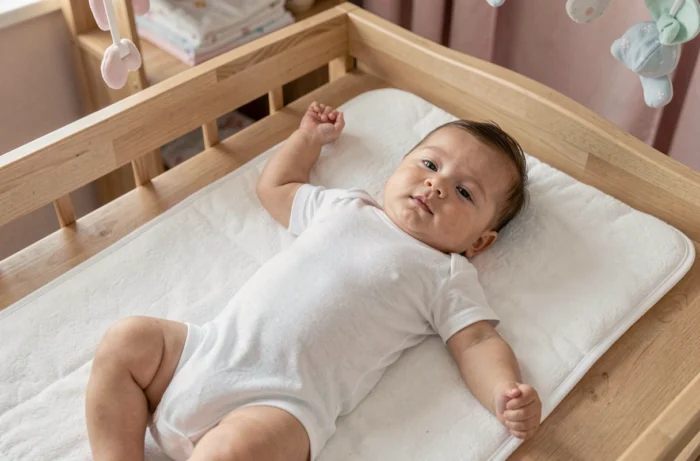
Sensory stimulation in the water: an intense neurological effort for infants
Bath time is not a passive experience. For a baby who is a few weeks or months old, being immersed in water activates several sensory channels at once, which their immature brain must process.
- Water touching the entire skin surface creates a continuous stream of tactile input, very different from the occasional contact of fabric or a hand. The baby’s nervous system receives information about pressure, temperature, and movement across the whole body at the same time.
- The sound environment changes: sounds resonate differently in a tiled bathroom, and splashing creates unfamiliar noises. The baby processes these auditory stimuli alongside sensations on the skin.
- Proprioception (the perception of the body’s position in space) is disrupted. Buoyancy changes the points of support, and the baby no longer feels the firm support of a mattress or someone’s arms. They must constantly recalibrate their sense of posture.
- The transition from warm water to the surrounding air creates a sudden temperature contrast, adding another source of stimulation.
Each of these sensory inputs would be manageable on its own. Combined over several minutes, they represent a considerable neurological processing load for a developing brain. As a result, the baby’s nervous system reaches a saturation point, triggering drowsiness as a way to recover.
Water temperature and bath duration: two factors that affect fatigue
Water temperature directly affects how tired a baby feels after a bath. Water that is too warm forces the body to release heat, while water that is too cool makes it work harder to produce heat. In both cases, the effort required for thermoregulation increases, making the baby more tired.
A longer bath amplifies the effect. An extended bath exposes the baby to continuous sensory stimulation and prolonged thermoregulation. Just a few minutes in the water can be enough to make an infant tired. Beyond that, every extra minute adds more stimulation without any particular hygiene benefit.
Adjusting bath time to your baby’s cues
Signs to watch for go beyond heavy eyelids. A baby who starts looking away, makes increasingly disorganized movements, or suddenly begins to cry may be experiencing sensory overload. These behaviors indicate that they are approaching their tolerance threshold.
Ending the bath at this point, rather than trying to extend it as part of the routine, can help prevent excessive fatigue. This keeps bath time enjoyable without letting it become exhausting.

Evening baths and falling asleep: the link lies in the drop in temperature
Many parents find that an evening bath makes it easier for their baby to fall asleep. This is not just due to accumulated fatigue. The effect is based on a specific physiological process: the drop in body temperature after a bath sends the brain a sleep signal.
During a bath, the body’s surface temperature rises slightly. Once the baby gets out, it falls again. This drop mimics the natural process the human body goes through as sleep approaches, when core temperature decreases to help us fall asleep. In babies, whose regulatory mechanisms are still immature, this effect is amplified.
A morning bath uses the same amount of energy, but the temperature signal conflicts with the baby’s circadian rhythm. The baby may feel tired without necessarily falling asleep.
What post-bath drowsiness should not hide
In the vast majority of cases, a baby who falls asleep quickly after a bath is showing a normal response. Still, it is worth staying alert: an infant who is unusually difficult to wake, whose skin remains mottled, or whose temperature does not stabilize deserves particular attention. Ordinary drowsiness is different from lethargy because a drowsy baby can still respond to gentle stimulation.
Bathing makes a baby tired through a combination of three factors acting at the same time: energy-intensive thermoregulation, sensory overload, and a temperature signal that encourages sleep. Adjusting bath time to the infant’s cues and preparing everything needed for afterward in advance are the simplest ways to turn this fatigue into a gentle transition to rest.


