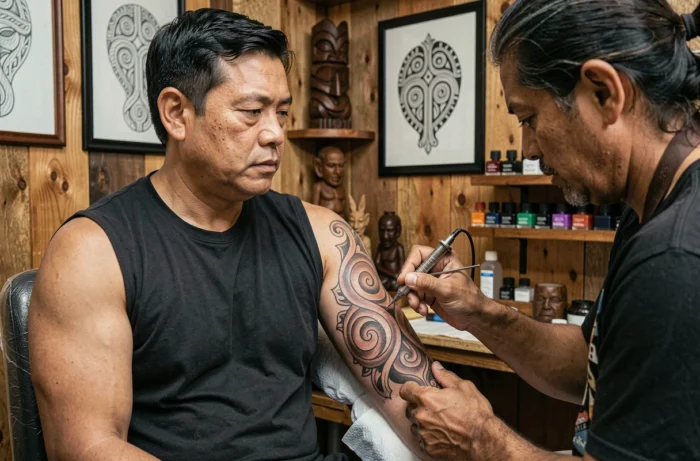
A Māori tattoo is not chosen like a design from a catalogue. Every composition tells a story connected to the person who wears it, their genealogy, their struggles and their aspirations. Copying a design found online means carrying someone else’s story on your skin, stripped of its meaning.
Kirituhi and tā moko: two terms to understand before getting tattooed
Have you seen the words “tā moko” and “kirituhi” used as synonyms? They refer to two very different practices.
Tā moko is reserved for people of Māori whakapapa—that is, those with a genealogical connection to an iwi (tribe) or hapū (sub-tribe). The design encodes the wearer’s identity: their ancestry, status and achievements.
Kirituhi, on the other hand, is for people without Māori ancestry. It draws on Polynesian visual forms without claiming to represent tribal affiliation. It offers a respectful way to wear a Māori-inspired tattoo, provided the design is custom-created. Before taking the plunge, it’s worth learning how to choose an authentic Māori tattoo by understanding this distinction.
Confusing the two risks claiming a cultural status that isn’t yours. A reputable artist will ask about this at your first meeting.
Why a design copied from the internet has no meaning
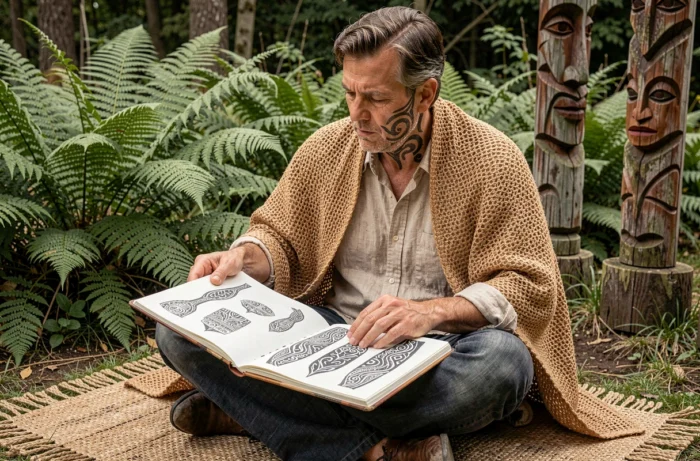
Image banks and Pinterest boards are full of Māori designs. The natural impulse is to pick one, print it out and show it to a tattoo artist. The problem runs deeper than that.
There is no universal dictionary of Māori symbols. A design’s meaning depends on the person it was created for, the context in which it was made and the relationship between its elements. Taking a symbol from an image found online and assigning it a fixed translation is misleading.
A koru (spiral) can represent rebirth or growth, but its size, direction and position in relation to other elements change how it is read. Two designs featuring the same koru can tell opposite stories.
Copying a design is like reciting a speech in a language you don’t speak. The form is there, but the meaning is gone. In some cases, the wearer may unintentionally display a story that reflects neither their life nor their values.
Authentic Māori tattooing: dialogue with the artist as the foundation
A respectful approach doesn’t begin with handing over a design to copy. It begins with a conversation.
An artist who practices kirituhi or tā moko works from your personal story. Here’s what the process involves:
- You share the defining events in your life, your values, family connections or struggles that you want to carry on your skin. The artist listens and asks questions.
- The artist creates an original composition by combining visual elements suited to your story. They explain each choice and its cultural limitations.
- The final design exists nowhere else. It is the result of an exchange, not a Google Images search.
A custom tattoo takes time—sometimes several weeks of discussion before the design is finalised. That time is part of the process. An artist who agrees to reproduce a design found online without asking questions is not following an approach consistent with the tradition they draw on.
How to assess a tattoo artist’s credentials
The portfolio is the first indicator. Look at whether each piece seems unique or whether the designs look similar from one client to the next. An artist who creates custom designs will show clear variations in shapes, placement and proportions.
Ask them directly: how do they approach kirituhi and tā moko? Do they distinguish between the two? Do they turn down certain projects? A practitioner who sets clear boundaries demonstrates cultural understanding that technical skill alone cannot guarantee.
Cultural appropriation and Polynesian tattoos: where is the line?
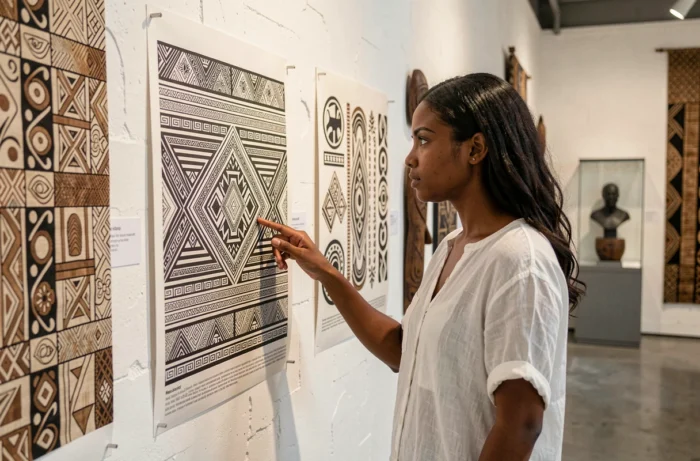
The debate around cultural appropriation and Polynesian tattoos is real, and views differ among artists and communities. Drawing a clear line between “allowed” and “forbidden” would be an oversimplification.
Here’s what practitioners who respect the tradition generally agree on:
- Wearing tā moko without Māori whakapapa is considered a direct appropriation of an identity marker.
- Kirituhi offers a legitimate alternative, provided the design is created through dialogue rather than copied.
- Certain placements, such as the face (moko kauae for women, moko for men), carry particularly strong cultural significance and are generally reserved for people of Māori ancestry.
Respect comes not from prohibition, but from understanding. Taking an interest in Māori culture, reading about its history and talking with artists who practice it can turn an aesthetic choice into a cultural exchange.
A Polynesian tattoo worn with an understanding of its origins and created in a respectful setting is not the same as a generic design downloaded from a vector website. The difference lies less in the design itself than in the intention and process behind it.


