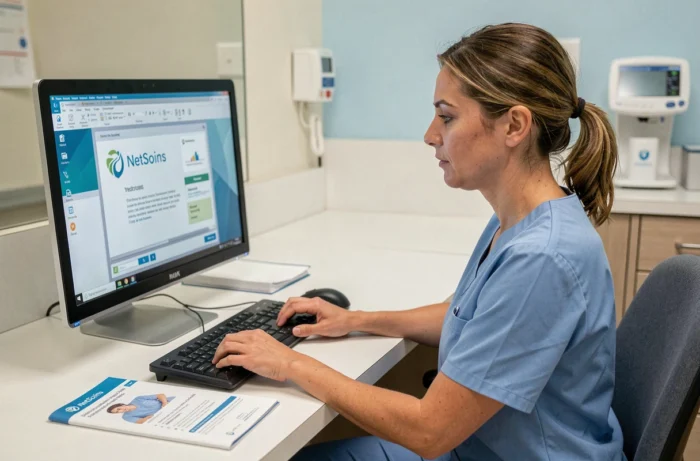
The Colisée group has rolled out NetSoins software, published by Teranga Software (now Orisha Care), across all its facilities in France. This rollout is part of a broader shift toward digitalisation in the health and social care sector, driven in particular by the national ESMS Numérique programme, which funds electronic care records (DUI), change management and staff training.
For care staff in nursing homes (EHPADs), switching from paper records or an older software system to NetSoins is about more than learning to use new buttons: it means changing everyday practices, and success depends largely on the support provided.
Nursing home care software: how NetSoins changes day-to-day work
NetSoins brings medical records, prescriptions, handovers between teams and some of the residents’ administrative records together in one place. Before its introduction, this information could be spread across several formats, creating a risk of loss or duplication.
Moving to an electronic care record changes how each professional records and accesses information. A nursing assistant, a coordinating nurse and a GP do not use the same features, or use them with the same frequency. NetSoins training at Colisée must therefore take these different roles and needs into account.
One point is often underestimated: having software in place does not guarantee that digital services are actually used. The electronic care record can be part of a wider pathway that includes the National Health Identity (INS), Mon espace santé and the secure MSSanté messaging service. If these services are not connected and actively used by teams, the software remains an isolated tool, far from reaching its interoperability potential.
NetSoins training and change management: two distinct approaches
Initial software training generally covers navigating the interface, entering care activities, viewing residents’ records and managing prescriptions. This technical foundation is essential, but it is only part of the work.
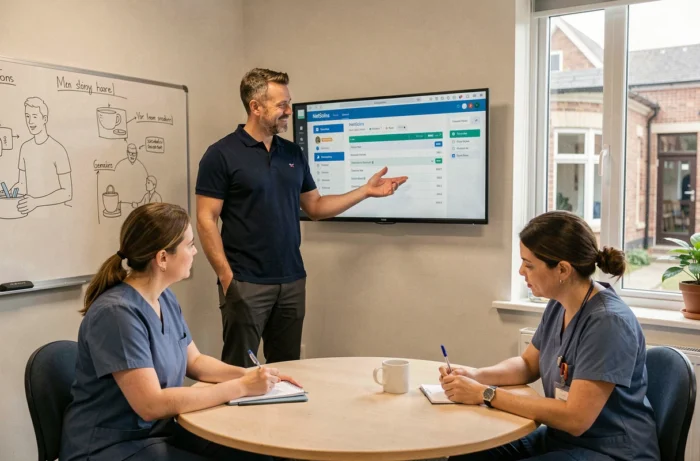
Change management starts before technical training and continues after it. It includes communicating ahead of the rollout, identifying team champions, gathering concerns and adapting the implementation schedule to on-the-ground realities. The ESMS Numérique programme recognises this distinction by funding project management, change support and training itself separately.
Confusing the two can lead to a familiar scenario: staff receive technical training but return to their old habits a few weeks after rollout because the organisational context was not prepared.
Tailoring training to professional roles
A single training programme for all staff rarely delivers good results. The needs of a nurse managing care plans differ from those of a care assistant who checks residents’ records occasionally. Creating role-specific learning pathways helps focus training time on the features staff actually use.
- Nursing assistants need to master targeted handover entries and daily care tracking, often using a tablet close to the resident.
- Nurses and coordinating nurses make greater use of prescription and treatment-tracking modules, as well as tools for coordinating with GPs.
- Management teams (facility directors and quality managers) use dashboards and monitoring indicators to oversee operations.
Handover quality: the real measure of successful training
Being able to navigate NetSoins says nothing, on its own, about the quality of the information care staff enter. An electronic record centralises information, but does not determine what should be handed over or how to identify information that will be useful to the next shift.
This offers a practical way to assess training effectiveness: can a colleague taking over understand the handover entries made after rollout? Do they contain relevant information about changes in the resident’s health, or are they limited to generic notes?
Training staff to write useful handovers means going beyond the software. It involves each care professional’s working practices, their understanding of how information flows through the facility and their ability to prioritise what they observe. Software training and training in good handover practices are complementary initiatives that work best when delivered together.
Post-rollout support: the often-missing link
Most difficulties arise in the first few weeks after switching to NetSoins. Care staff encounter scenarios not covered in initial training, forget certain steps or find themselves in situations where the old approach (paperwork or a phone call) seems quicker.
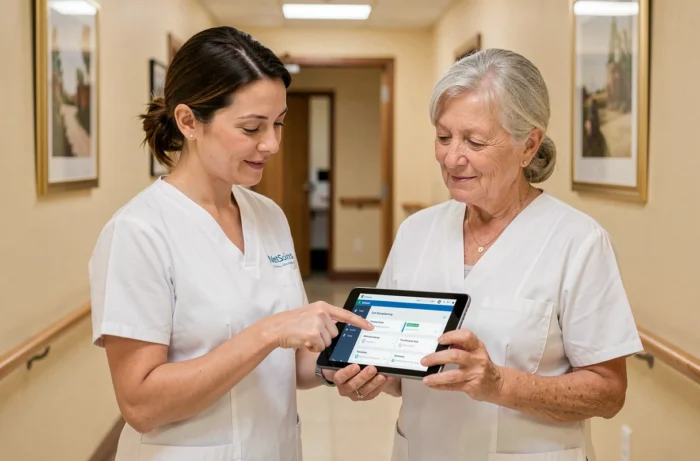
Having support available directly within the facility makes a difference at this stage. Internal champions, trained in advance and known to their colleagues, provide day-to-day support. Without this network, requests for help go to a remote technical support team, where response times may not match the pace of care work.
How to maintain skills over time remains an open question. Staff turnover in the health and social care sector means new employees regularly arrive without having completed the initial training. Refresher sessions or additional modules are then needed to prevent usage levels from gradually declining.
Key considerations for Colisée facilities
- Allow for a period of dual entry (paper and software) during the transition, keeping it as short as possible to avoid embedding parallel practices.
- Document use cases specific to each facility, as residents and working arrangements vary from one home to another.
- Include personal data protection (GDPR) in the training, since electronic resident records contain sensitive health data.
- Measure actual software usage a few months after rollout by analysing how often and how well information is entered—not just login rates.
Rolling out NetSoins across Colisée facilities involves far more than changing IT systems. Success is measured by how care staff use the software day to day—in the quality of handovers, the smoothness of coordination and the time genuinely freed up to support residents. As long as training is treated as a one-off event rather than an ongoing process, there is a risk that staff will revert to old practices.


